Dirk
Members
-
Joined
-
Last visited
Everything posted by Dirk
-
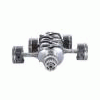
Cheers Backwoodsboy. Yes it is an EA71 and yes I did do a full rebuild less than two years ago but I did not replace the wrist pins. Had I noticed any slack around the pin I would have done something about it. Unfortunately I did not measure the clearance scientificaly which could be my undoing. The cylinders were in good condition. If it were piston slap would I have seen any obvious signs? I have learned recently that I am not the first to have re-built this engine. Makes me wonder if the heads have been skimmed one too many times or cylinders honed one too many times. I know where I can get over sized pistons so if I choose to go the long route at least I am tooled up for it. I won't happen in a hurry though since I don't have a pot to piss in right now.
-
On my EA71 its just a case of removing four 10mm bolts and gently twisting and pulling the pump out of its socket. Leaving the oil filter on gives you something to hold on to when doing this. No idea if you have the same pump style. Mine is mounted on the lower front of the engine and is driven by the cam shaft.
-
So I have a sloppy wrist pin. My question is: Where is the wear likely to be? If the wear is in the pin itself or even the piston then I may be able to rectify the problem by simply removing the head to gain access. If the wear is in the connecting rod, then it looks like another complete re-build. I would like it to be the first option however I am reluctant to start removing heads without being at least 80% sure that the issue lies there and not in the rod. Comments and opinions please?
-
I wonder if it is worth checking the engine oil specs? Ihave lots of other ideas and suggestions but I don't feel qualified enough to voice them publicly. There is a thread here some where that suggests you can raise the presure of a tired oil pump by adding a small washer behind the pressure release spring. You can find this spring by removing the 18mm bolt at the opposite end of the pump facing away from the filter. I found that a 10 gauge screw head works well as a spacer. I just cut most of the thread off the screw. No Doubt another member will be able to tell you whether this is a good idea or not but it doesn't seem to have hurt my engine in any way. I would however be interested to know what the consequences of too much oil pressure are.
-
Since we now have a little daughter and only one income the prospect of aquiring a shiny new Weber Carb is a distant dream for me. So for now I settle for the enjoyment of taking my little mechanic apprentice to the breakers yards in search of a carb in better nick than my own. I am on my third carb now but to be honest it is just as worn out as the first. But what has interested me in my quest is this: Although each carb appears to be the same hitachi body, the jet sizes seem to vary some what. Now without proper measuring equipment I cant say for sure if the barrels of these carbs are exactly the same size but they do come from the same model engine (EA 71) of varying years. So how is it then that the jet sizes to differ from the same capacity engine? Is there a variable (other than human intervetion) that I am missing? The jets I am currently using are mostly the origional sizes since they seem to work best (don't fix it unless its broken) but I have noticed on other threads that some of you have altered jet sizes to achieve slightly different driving characteristics. I myself have upped the size of my primery idle jet with pleasant results but I wonder if the rest of the jets are optimally set. And finally the question: Is some one able to tell me what the physical and driving characteristics are of an engine that runs either too lean or too rich? I think I have some of the answers but for now I will save myself potential embarrassement by keeping quiet. I guess that someone will tell me to get the engine professionally tuned but lack of cash and a carb that leaks air from every orifice tell me not to at this stage. So what I am asking for is advice on tuning the agricultural way.
-
Good on ya mate! Happy days.
-
Thank you GD So I won't hear a ping when over advanced until I put the engine under load. Correct? I must say though, I find it hard to recognise pining on my engine. Its very obvious in my wifes Toyota but I can't pin it down as easily on mine. Is this just me or is it a boxer phenomenon? Also is the article correct in saying that you can run a lower octane fuel by retarding the timing? And would I notice any drop in power?
-
Sound advice. Cheers
-
I still think it is a timing issue. My guess is you are still too retarded. I would think that at 1250 rpm the timing might want to be as much as 20 degrees BTDC. Is the engine getting over warm?
-
sorry. I meant fast idle screw.
-
Okie dokie. Timing is correct. Idles at 1250rpm. What is the throttle screw up to? and how does the float level look. I'm not sure why it won't idle any lower than 1250 but it has little to do with the accelerator pump. All the pump does is give a little extra squirt when you floor it. the rest of the fuel comes from the main jets and the power valve. The misfire sounds to me like an ignition fault. If the timing is correct then you might check the condition of the points and points gap, the dizzy cap for cracks, the condenser and the coil.
-
I had a hell of a time with a similar problem not long ago. It turns out that the flywheel I replaced had completely different timing marks on it. You didn't happen to change yours too? Find TDC and see if the marks correspond.
-
A mechanic friend of mine is forever telling me to run my EA71 at 10 degrees btdc because its an old engine and because of modern fuels. I have tried this but have always reverted back to the subaru specs since it doesn't seem to make much difference. Recently I found this fascinating article which seems to suggest the reverse. http://www.faqs.org/faqs/autos/gasoline-faq/part3/section-1.html As far as I can tell it would appear that low octane fuel is more volatile and so requires a retarded timing and high octane fuel burns slower thus requiring advanced timing. The logic is there but it goes against the grain of everything I have been told to date. Comments and opinions please? A further question follows: Unleaded fuel was introduced in the mid eighties. Therefore one would imagine that engines built prior to then would have been designed to run on unleaded fuel which it would appear had an octane of 97 plus RON by the early eighties. So what does this mean for these early engines that mow have to run on unleaded fuel? What octane is really best and is it politic to start messing with the timing?
-
The sound is a consistent mechanical noise. I guess the answer here is the wrist pin then. Shame, I was hoping for a quicker fix. The sound was present before I re-built the engine and when I did I inspected all parts pretty thoroughly. I guess not thoroughly enough. That said, any play in that pin must be fairly nominal for me to miss it and the engine doesn't seem to suffer much for it. Think ill just live with it until the next re-build. Thanks so much for all your help. It is at least nice to know what the problem is.
-
Ive just been fiddling with the timing. Whether I advance or retard, it makes no difference. I guess this rules out the octane theory? The noise deffinately gets worse as the engine gets hotter. At this stage the wrist pin looks likely although I would still like to explore the possibility of pre-ignition. Not sure if I can get hold of a laser thermometer. What about using a colder spark plug? Which would be a higher number right? Currently using 6bps.
-
wrist pin is the one holding the piston on its rod, right? Can't garantee that its a text book ping but it at least sounds very similar. You are quite right about me not being able to hear the noise at higher revs. It is possible that it is still there. No erg valves. My rocker vent hoses are currently venting in to Red Bull cans. Im still suspicious that the sound dissapears when there is no spark. Looking into octane ratings and timing at the moment. Its a 1979 EA71 so I guess it was origionaly designed for leaded fuel. Currently using premium fuel which here in New Zealand is between 95 and 97 RON. I wonder if this is also a factor?
-
I checked my valve clearances this morning and they are perfect. Had a look at the spark plug and it seems healthy. The valve lifting rods were in good order when I last saw them and in any case the noise dissapears when I remove the plug lead. This suggests to me that it is not a mechanical problem. I thought pinging only occurs under engine load but the engine is fine under load and at speed. It only pings like this at idle and under very light load and only when the engine is warm.
-
I did it from underneath with a couple of wheel ramps. I swore a lot and did not enjoy myself. Since then I have done it from the top and found the whole excersise more enjoyable. Plus I was able to re- torque my heads and set the valve clearances easily. Pretty much a good opportunity to have a really good spring clean under the hood and do a full tune up.
-
My No3 cylinder pings at idle. It does this mostly when its warm but if I remove the plug lead the ping dissapears. The symptom is not present under load. Its an early EA71 engine. no mods. I re-built the engine two years ago so bearings are all good and all else in there seems to be fine. Cylinders honed, new rings, valves re-seated, new oil seals, new bearings, heads skimmed etc. Timing is correct spark plugs are correct valve clearances are near enough carburetor is fine too although a little worn. Ignition system is new Oil pump in good nick recent compression check perfect. I have searched through the threads but not yet found my particular problem. Pretty sure this is not the Tick of Death since my valves are mechanicly lifted. I was wondering if I am getting pre-ignition for some strange reason. Compression check was spot on but I just get the feeling that this cylinder may just be getting to hot. Or perhaps a burning carbon deposit. It also occured to be that the master vac hose connects to the mannifold on this side. Could it be leaking extra air into the cylinder running it leaner and hotter? Does any one have ideas or a specific thread to look at? THanks in advance
-
Hello all. I have a DCJ 306 carb on my EA71. I found a second hand one that I wanted to use as parts but it seems the jet sizes are different, even though it came from another EA71. Does anyone have the correct specs for me? Regards Dirk.