jonathan909
Members
-
Joined
-
Last visited
Everything posted by jonathan909
-
Does the early (e.g. '01) H6 use the same shims as the EJ25D?
-
jonathan909 replied to SiriusBlack's topic in 1990 to Present Legacy, Impreza, Outback, Forester, Baja, WRX&WrxSTI, SVXLiving out in the woods, I've never run across one of these things in the wild. Seems like a solution in search of a problem. I mean, how much oil will it actually recover in an engine that still has half-decent compression?
-
jonathan909 replied to jonathan909's topic in 1990 to Present Legacy, Impreza, Outback, Forester, Baja, WRX&WrxSTI, SVXYeah, I know what I'm doing. Engineer accustomed to working on and around dangerous things, etc. Jig it up so it's not going to be inclined to exit in any direction, and only for the purposes of compressing a couple of inches and seeing if the readings that come back make any sense. In this case absolute accuracy isn't even important, as the measurement will tell me whether I can expect a relative improvement between one spring and the next.
-
jonathan909 replied to immulmen's topic in 1990 to Present Legacy, Impreza, Outback, Forester, Baja, WRX&WrxSTI, SVXMy question as well - the number is meaningless without one from a known-good injector to compare it to. I was thinking about this. If an ECU output driver is blown (i.e. shorted) and turns on the injector full-time, will exceeding the injector coil's duty cycle burn it out? If one doesn't mind sacrificing a junkbox injector, it could be lashed to a 12V supply (or whatever it's supposed to run at), then wait and see.
-
jonathan909 replied to jonathan909's topic in 1990 to Present Legacy, Impreza, Outback, Forester, Baja, WRX&WrxSTI, SVXInteresting, thanks. But I quickly note that the springs for the three models we're actually talking about: '01 OBW, Baja, and Forester (all stock) aren't included! I can't imagine Subaru burying the spring specs in the service manual under a testing procedure, but I suppose it's possible and worth a look. I was actually thinking about gathering some empirical data - putting a spring in the hydraulic press and seeing if I can get any meaningful readings out of it. Easily enough done with the spring from my car and a Forester spring from the junkyard, but I don't think my pal with a Baja is going to want to let me yank one of his out just for fun and games...
-
jonathan909 replied to jonathan909's topic in 1990 to Present Legacy, Impreza, Outback, Forester, Baja, WRX&WrxSTI, SVXRemember, we had this whole conversation over whether the rear coil-over-spring qualifies as a "strut" at all. This OBW has a single bolt through the knuckle. But that shouldn't matter, because the shocks are new and all I want (hope?) to do is replace the springs.
-
jonathan909 replied to jonathan909's topic in 1990 to Present Legacy, Impreza, Outback, Forester, Baja, WRX&WrxSTI, SVXOkay, but now we're going in circles. I originally asked about Forester springs because that's what I recall having been previously discussed. Then someone said "Baja", and now we're going back to the Foresters. From a cost perspective, I'd prefer Foresters because right now there are half a dozen of them in the local P'n'P yards, and as I said above, Bajas would have to be bought new. So is one taller and/or stiffer than the other? Which is preferable from the performance (load) standpoint? The good news (at least for my trailer) is that the tongue weight is spot on - 158 lb., right where it should be.
-
jonathan909 replied to idosubaru's topic in 1990 to Present Legacy, Impreza, Outback, Forester, Baja, WRX&WrxSTI, SVXI'm glad you were able to solve your problem, but what you did can only be described as a "cargo cult" repair. Baking soda does not contain electrical repair magic. It's used to clean BATTERY contacts because batteries contain acid, and the acid creeps out to the post and causes corrosion. There is no acid in an alternator (H4 or H6), and thus no acid to neutralize with an alkali such as sodium bicarbonate. You might as well have cleaned that connector with snot, because it was probably the act of cleaning the toothpaste out of it that restored the contact's functionality. Granted, baking soda toothpaste is probably a little more abrasive than non-baking soda types, so that may have helped, but that still doesn't make it appropriate for this application, any more than it would be for relighting a burned-out headlight. Go get a can of electronic contact/control cleaner/lube. In a pinch even brake cleaner is okay, because the combination of aerosol spray and degreaser will help free up crap from the contacts and not leave residue.
-
jonathan909 replied to immulmen's topic in 1990 to Present Legacy, Impreza, Outback, Forester, Baja, WRX&WrxSTI, SVXSure, it's the first in line for fuel, but a tube is a tube and I don't think that's going to make much difference. If the injector in the same position keeps giving you trouble despite trying a bunch of different injectors, I'd be inclined to look at the wiring to that injector.
-
jonathan909 replied to jonathan909's topic in 1990 to Present Legacy, Impreza, Outback, Forester, Baja, WRX&WrxSTI, SVXAbout the turbo thing: Dealer says same spring for NA and turbo. Or maybe that's why there are two part numbers, but they can't confirm. Why the Forester springs rather than Baja?
-
jonathan909 replied to jonathan909's topic in 1990 to Present Legacy, Impreza, Outback, Forester, Baja, WRX&WrxSTI, SVXUnsurprisingly (since a local full-serve wrecker said there's nothing on the continent) not. Surprisingly, not much by way of listings in their parts chooser pulldown for springs at all.
-
jonathan909 replied to jonathan909's topic in 1990 to Present Legacy, Impreza, Outback, Forester, Baja, WRX&WrxSTI, SVXYeah, it's a hack. Appropriate? I dunno... $141 USD (the starting price for Subaru applications) is $188 canuck, plus shipping, and I'm sure it'll be more than the dealer just quoted me for the Baja springs - which I'm sure are the better way to do it.
-
jonathan909 replied to jonathan909's topic in 1990 to Present Legacy, Impreza, Outback, Forester, Baja, WRX&WrxSTI, SVXAvailability: The dealer tells me that Baja parts are being discontinued fast, but they do have a few pieces of the 20380AE50A spring at a reasonable price - $104 canuck. Curiously, they also have one piece of the 20380AE52A for a little more ($114) but have no indication what the difference is, if any. As far as the wreckers go, the local full-service yard I spoke to says there are no Bajas listed on the entire continent.
-
jonathan909 replied to jonathan909's topic in 1990 to Present Legacy, Impreza, Outback, Forester, Baja, WRX&WrxSTI, SVXI've never used one; not hard to understand how and why it works, but I don't think it's appropriate here. When you look into them, you find assumptions like "pickup truck" and "trailer weight 5000 lb and over", so that suggests that they're pretty severe overkill for this application. I just got back from the scales, and the weight came in at exactly 700kg (1540 lb), which isn't a surprise given the published weights don't include the added front wheel/stand, boat mounts, gear stowed in the sailboat, or (probably) the gas in the jet ski. So the question now is what the actual tongue weight is and whether it can be dialed in to ~150 lb, which is pretty modest. And since it's a 20+ year old car it seems to me that the springs are softer than they should be, so does it make sense to add all that heavy-duty hardware to correct what's really a pretty small deficiency?
-
jonathan909 replied to jonathan909's topic in 1990 to Present Legacy, Impreza, Outback, Forester, Baja, WRX&WrxSTI, SVXThanks. I'm going to cast about for the Baja Turbo springs, but at first glance that doesn't look like an easy acquisition - Bajas are pretty rare (at least around here, and none listed in either of the local P'n'P's inventory), making a turbo tougher yet. Rock doesn't list springs for them, and I shudder to think what a dealer will ask. I'll check with the usual local aftermarket parts shops today and maybe see if the full-service wreckers have anything. Previously unfamiliar with King - that experiment looks like it'll cost as much as the car did, esp. factoring in shipping from Oz... Any hints where I might have better luck looking?
-
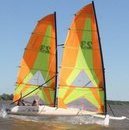
Just got back from a few days in Montana with all the crew and kit. The new KYBs (inside old springs) in the rear have certainly helped, but more is needed. When fully loaded and with trailer, the rear of the car is depressed by as much as 3", based on quick measurements taken along the running-board trim. The trailer w/ boats is, based on the published weights, roughly 1200 lbs., so the tongue weight should be about 120 lbs. I'm going to measure this (as well as try to confirm the trailer's gross weight), and suspect it's on the high side. Since I can't really do anything about the load distribution (the Sea-Doo and sailboat fit where they fit), the tweak that's available to me is moving the (single) axle forward - I think I have about 6"of latitude there. But if I want to stiffen and/or raise the rear end so it's as close to level as possible under load, what are my options? I'm trying to be purely practical here and not look like some jacked-up dope. I seem to recall discussions of Forester components being used in cases like this. Or do I just have to shop for stiffer springs? Any direction greatly appreciated.
-
Yeah, all adhesives are different and you have to experiment a lot. I used to love Freon TF for just about everything, but those days are long gone. So the "inconspicuous area" rule rules. Acetone, any citrus-based cleaner, isopropanol, and my new favourite, 95% ethanol - Everclear. Now that the border's open again, I've been getting the 1.75 litre bottles duty-free for $20 - way cheaper than isopropyl, and you can drink it!
-
jonathan909 replied to CodemanLivs's topic in 1990 to Present Legacy, Impreza, Outback, Forester, Baja, WRX&WrxSTI, SVXSheeeeeeeee-it.
-
jonathan909 replied to CodemanLivs's topic in 1990 to Present Legacy, Impreza, Outback, Forester, Baja, WRX&WrxSTI, SVXThere are other hacks I've read about for this pesky 0420 thing - one is to use drilled-out spark plug antifoul spacers to back the sensor out of the exhaust stream a little. Is there anything to that approach?
-
jonathan909 replied to CodemanLivs's topic in 1990 to Present Legacy, Impreza, Outback, Forester, Baja, WRX&WrxSTI, SVXSo this hack was just about slowing down (damping) the response from the sensor.
-
jonathan909 replied to CodemanLivs's topic in 1990 to Present Legacy, Impreza, Outback, Forester, Baja, WRX&WrxSTI, SVXLook to the exact schematic for your model and year. My guess would be that the wires go straight from the ECU to the sensor (i.e. no fuse between), so you're probably down to a wiring fault.
-
jonathan909 replied to CodemanLivs's topic in 1990 to Present Legacy, Impreza, Outback, Forester, Baja, WRX&WrxSTI, SVXMy understanding is that you're safe in swapping the ECUs, as they're the same in both AT and MT cases, and there's an input (via the connector/harness, of course) that informs it which type of transmission is in place. The (automatic) transmission is managed by a separate controller, the TCU, which communicates with the ECU. I assume you've restored your O2 sensor "mod" to its original state.
-
jonathan909 replied to mrfixiter's topic in 1990 to Present Legacy, Impreza, Outback, Forester, Baja, WRX&WrxSTI, SVXYeah, that's a new thing I'm seeing too. I don't like it either - it takes up too much screen real estate. If I want those stats I know where to find them. Who's messing with the configuration and why?
-
jonathan909 replied to Daskuppler's topic in 1990 to Present Legacy, Impreza, Outback, Forester, Baja, WRX&WrxSTI, SVXIt's not magic. Deforming a big chunk of metal takes a combination of time, force, and heat. You didn't hit it, didn't overheat it, and there wasn't much time. And yeah, I know "they" say that, but (and I'm the first to admit how limited my experience is) I usually go with "if it ain't broke, don't fix it". If you can't prove that it's out of flat, why start milling? Subaru's book of words tells you what the flatness requirement is. So I get out my machinist's rule and feeler gauges, and if it meets spec it doesn't go out for a shave and a haircut.
-
jonathan909 replied to Daskuppler's topic in 1990 to Present Legacy, Impreza, Outback, Forester, Baja, WRX&WrxSTI, SVXI can't begin to imagine why.