pontoontodd
Members
-
Joined
-
Last visited
Everything posted by pontoontodd
-
-
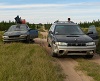
Monday morning we took the highway south to the stunt area south of Seney. When we got to town we filled up in the gas station where we'd flushed out B's clutch on a previous trip. Got to the stunt area and M&B realized it was a lot bigger than the little section we'd looped around you can see from the dirt road. Drove back in it and through some big sand bowls and kept going to a big banked turn and hill climb. Climb wasn't as bad as it looked at first, B and I got up it on the first try but Z took it too easy on the first try and had to get a bigger run at it and made it to the top. From there it kept going, there was a little loop/bowl around a tree that I made but B got stuck in. Z pulled him out, ran the loop a couple times, and we kept going until we got to a different gravel road. Went back through the stunt area a different way to the dirt road. I decided to hit a small uphill jump. Got decent air at about 30mph but it was difficult to get a good run at it through the soft sand to hit it faster than that so we continued south, mostly off pavement down to 2. When we got back to pavement we cleaned out our wheels at an abandoned gas station (otherwise they shake from imbalance). There is an axleshaft poured into the concrete. M thought it was a cheap substitute for rebar. Maybe the person who put it there is trying to confuse the next species of intelligent life on earth in a few million years with this strange fossil. Got down to the test hill I wanted to hit but the path we normally take to get to it was blocked off and it would have taken a long time to “drive around the block”. At this point B was getting a shuddering in the rear of his car occasionally and noticed his RR wheel bearing is a little loose. We stopped at a gas station to make a decision, at this point we would be heading west to the super whoops so Z would probably have to backtrack to get home. He made up his mind with a coin flip that determined he'd follow us to the super whoops. We got some video driving alongside the Outback going through the little whooped out trail along the pavement leading to the ORV parking lot but it wasn't ideal since the grass in between the cars was pretty tall. We ran the super whoops a little and measured the larger ones. The rear end of the Outback was kicking up a bit on a few of them. We made PB&Js and at this point Z decided to follow us down through Wisconsin as it was probably faster than going back over the Mackinac bridge. Mike had left the burger patties for the trip in his apartment so we'd already decided to cook those in his parking lot before we all split up for home. Not far from Milwaukee we saw an Outback XT with some mud on the sides towing a teardrop trailer. We kept seeing it when we were stuck in a slow moving traffic jam. When we pulled off the exit to go to M's apartment they followed us. We were wondering how long they were going to follow us so I rolled down my window and waved for them to follow us around one of the last turns. We introduced each other and we invited them to join us cooking out. The husband had built the trailer about five years ago and it was still very nice. He'd also done some modifications to the engine of his XT running E85 and 22psi of boost. They had some brats and veggies that were added to the menu and they stayed for hours as we all eventually left for home. Overall a good trip, cars all held up pretty well. The guys learned one of the reasons we made better struts. Outback went through 1.5 quarts of oil. Have seen a few clouds of oil smoke at startup in the last month including one when I parked the car with one side jacked up overnight on the trip. On the plus side the last couple times I checked there is no noticeable blowby now and it ran fine all weekend so I'll probably leave the engine in at least for the next trip. Plan to replace the other u-joints in Outback driveshaft. While that was off I noticed there's quite a bit of backlash in the rear end so I want to check that out. RF CV axle made noise all weekend and LF was leaking grease by the end so those both need to come out. Clutch got used hard so while the driveshaft and axles are out it's not much more effort to pull the trans. Need to adjust parking brake. One radiator fan is rubbing on housing and the other one wasn't working despite having a good fuse so need to check those over. HVAC controls still not working so I should sort that out. Need to replace at least the RR wheel bearing on B's car. Really needs softer springs to lower it before our next big trip so we don't have to take a dozen spare CV axles with us. We now know that the ball spline axles are junk. Still need to get the center blockoff plate mounted to Z's bumper, he ran out of time with the sanding and painting on it and putting the bolt on wheel bearing front spindles, smaller front brakes, and 15” wheels with mud tires on his car.
-
View from our campsite Sunday morning: In the morning we packed up and headed west. Took a washed out road down to this river. The climb back up was challenging but not quite as bad as it looked. A got the Outback stuck on a stump near here and Z decided it was a good place to get a picture. Again the Foresters were starting to run low on gas so after some trail riding we went to Grand Marais on the highway. There was a triathlon and possibly some other things going on in town so it was pretty crowded. This guy was directing traffic with a stop sign he'd pulled out of the ground. We got gas, ground beef, beer, etc at the gas station. This guy was selling dreamcatchers and other things out of his Cherokee. Don't worry, the interior was also spray painted gold and decorated with drift wood. Then we decided to just run the highway down to the bar and unload some of our stuff there. It was early afternoon and I'd seen some trails and lakes just east of the bar so we wandered in that direction for a few hours. We decided to hit the wheelie jump and C's pond and see if we could get through on some roads that were flooded in June before we went back to the bar to cook dinner and settle in. We were able to easily drive through C's pond and continued west. Neither road that was flooded in June was flooded at all and I decided to head north to go back to the bar on a smoother gravel road than the whooped out snowmobile trails we'd been on. When we turned around D got the Outback stuck in the soft sandy road temporarily and I was able to barely drive it out on my first try. Z also had difficulty but B had an easier time due to the low range. When we got back to the bar we raised the passenger side of the black Outback with the jack again and M took the nut and washer off the end of the control arm and I ratchet strapped the wheel forward and he packed the remains of the bushing with RTV to try to minimize the slop and noise. Put the washer, nut, and cotter pin back on and left it to cure overnight.
-
Soldier lake Saturday morning: In the morning we paid at the honor box and trail rode up to the giant hill climb we'd found a couple years ago. Pictures really don't do it justice but this is the top. We stopped at a park just west of there, walked down to the beach, went to the bathroom, and then drove across the highway to ride trails west. In the distance in this picture you can see the bluff that the hillclimb goes up. After a while we started hearing a bad clunking noise from the rear of the Outback so I got out and watched M drive a bit, sounded like it was coming from just in front of the rear suspension. Figured out it was a bad u-joint so we got off the trail, jacked up the car, and M pulled the rear half of the driveshaft. The cross had actually broken and at first I was nervous but then remembered I had spare u-joints so I swapped it out and we put it back together. These have been in the car for about five years. The downside is since the cups are thicker walled than stock and the cross is hollow it's weaker than stock. The upside is that it's easy to replace on the trail. The u-joint at the trans seemed loose too but we decided to leave it and it lasted the rest of the trip. Later on D was driving my Outback with M navigating and they hesitated to make a turn and got stuck in a soft sandy intersection. I told him to stop trying to get out when smoke was coming out from the clutch and the car wasn't moving much. We aired down the tires to about 15psi and I drove out on the first try. I think it was in this section I got the Outback stuck in a big mud hole that B bypassed in his Forester and pulled me out. It was halfway up the door on the driver's side, not quite as deep on the passenger side. There was another even deeper mudhole ahead and I think due to this blockage we had to make a big detour around to get to our campsite. After a while I noticed the temps were creeping up a bit and the fans weren't running, both fuses were blown. There were only a few spares under the fuse box cover so I put in a 20 and a 30 and the 20 immediately flashed out. Later in the day someone noticed there were occasional rubbing noises in Z's Forester. Both rear spring perches were shiny and the tires were extremely close to the strut tubes and spring perches so the rear struts had probably bent a little. We jacked up the car, removed the wheels and tires, and Z hammered the spring perches. I think about this time I aired up. We eventually headed back north up another highway towards the campsite on the bluff I wanted to stay at on Saturday night. When we were within about 20 miles we rode various trails for an hour or so on the way to the campsite. I was relieved to see it was unoccupied on Labor day weekend and the guys who hadn't seen it before thought it was awesome and worth the drive. After we'd been there at least an hour, someone drove there with an FJ cruiser and turned around, they may have planned on camping there and fortunately we'd gotten there first. A cooked dogs, we set up tents, I started to replace a control arm bushing that was blown out on the Outback but then stopped when I realized my spares were pretty rough too. I left the car jacked up on the side to help drain mud/water out of it and left the doors and hatch open overnight. I dug out a few more 30 amp fuses in camp to put one in to power the fan and put a couple more in the fuse box cover for easy spare access. After we'd set everything up and eaten dinner and were hanging out around the campfire I saw a few people down on the beach a half mile away. Eventually one guy with a purple/UV flashlight was slowly heading towards us along the beach. A few of us walked down to the beach to see what he was doing. He was concentrating so much on looking at rocks with the flashlight he didn't notice us until we were about twenty feet away. He was a typical old yooper guy and explained that someone was trying to find an easy way to find agates (a semi valuable stone found along Superior that's often sold in gift stores, etc) and tried using a UV flashlight at night about a month ago. Didn't find agates but started finding rocks with portions that glowed under a UV light. They sell them as yooper rocks in the gift stores and on ebay and he was saying a rough one about an inch across goes for about $25 on ebay. Sounds like they get cut, polished, and made into jewelry (earrings). After talking with him for about five minutes he asked if we had any pot. Must be a side effect of UV light. We all laid down on the beach, looked at the stars and milky way and small northern lights since it was a clear night and talked for about a half hour.
-
Drove up to the UP over labor day weekend for some trail riding and camping. Most of us met up north of Milwaukee at M's apartment Friday morning. As we and Z were all getting to the UP, B said that we should replace one of his CV axles that was making a ton of noise. It was the front ball spline axle, we replaced it in a gas station parking lot east of Escanaba. The inner CV housing was blue but the boot was intact. Met Z in Naubinway around 1 or 2PM EST. This is how his bumper turned out: Used PDF of Mackinac county on Avenza, sort of useful. One issue was that your location on the map is just indicated by a small gray circle. There is a small arrow next to it to indicate direction but it seemed to point the opposite way of where we were going. I did use both tablets for navigation using mytrails most of the weekend with two different maps at different zoom levels, that was more useful than just one. We hit a lot of overgrown trails or trails with trees fallen across them that we cleared out and eventually connected to other trails, where they normally seem to dead end. Also found a bunch of stunt areas, at least four. At one of them a pair of women we'd seen hiking along the road walked by and one of them commented on how she had a Subaru and shouldn't have to worry about getting stuck in the snow after seeing us driving in soft sand. B tried the low range but it just got bogged down. Not many jumps or whoops this weekend but lots of fun sandy trails. Camped at Soldier lake Friday night, came in off some narrow trail to find out the campground has a paved loop and running water. Nearby are east soldier lake and a small lake called toy soldier lake. Fortunately we found a site that wasn't reserved for Friday night fairly close to the pit toilets so we camped there. A cooked burgers while we set up the tents.
-
Do you know what that structure used to be?
-
While the engine was out of the white Outback I tested out whether the H6 engine mounts can simply be switched side to side to provide some engine setback. This is how they look in the stock orientation: The bolt holes don't quite line up on the engine if you put them on the opposite side but a little slotting would solve that. I think the pads that bolt to the engine are not parallel to the pad that sits on the crossmember so it would put some stress on the rubber when the nuts are tightened. The pads don't sit flush on the crossmember when switched side to side either (or I would have taken a picture) but that could probably be fixed with some hammering. Swapped some other parts over to the engine and trans from the parts car. J stopped by Saturday morning and helped me get the engine and trans in the car and mostly hooked up. He left just before B got to town. B called saying that he'd blown up the ball spline rear axle just as he got to town. Balls and pieces of cage fell out when he reached under to feel how badly it was shot. I loaded up the towbar, lights, and chains and drove the black Outback out there to tow him back. Just before I got to him the engine started running rough again. I let it idle and tried plugging the coil packs back in, one of them seemed to smooth it out a little and it's been running fine since but had no unusual trouble codes (always has torque converter and evap codes now). First we finished hooking things up on the white car, started it up on stands. I'd forgotten to connect the trans cooler lines at the trans so that puked some ATF out before we noticed and shut it off. It took almost twelve quarts of trans fluid to get it full while running. While we had the front suspension halfway apart and CV axles out, we decided to put on bolt on front wheel bearing knuckles (thanks Slammo). I had one new wheel bearing and one with about 12k miles on it from the black Outback with no slop. Antiseized bearings and new ball joints in them, had to turn up a couple sleeves for the top eccentric bolt (I have long travel struts set up a little different than stock with two modified eccentric bolts). The front dust shields were rubbing badly, bent those in as best we could with everything assembled, but the driveshaft was rubbing on the exhaust under engine or wheel braking. I vee cut the exhaust where it was closest to the driveshaft and welded it back together so it has at least an inch of clearance now. Over the winter I'll probably replace that center section of the exhaust with something stronger and replace the engine and trans mounts. Other than that it seems to run better than the old engine. Haven't driven it fast yet to see if it downshifts smoothly. Thinking about putting a JDM engine in the black Outback before a week long off road trip (or two) we're planning this year. The blowby worries me a little and I'm not positive I've solved the intermittent rough running when warmed up symptom. Tempted to put in an EZ36 but probably won't. Anyone know how worried I should be by the blowby and if there's something else I should check that would cause it to run rough sometimes when warmed up but not throw a code?
-
Some tips on replacing an EZ30 and 4EAT in a 2002 Outback (all stock): Move the large AC line along the firewall out of the way. Managed to pinch that a bit between the pitch stopper brackets when removing engine and trans and it started leaking where the hose is crimped to the line. Fortunately I have one from a parts car. Drain the trans. I had a drain pan under the tailshaft when I pulled the driveshaft out and at first nothing came out. Unfortunately to remove the engine and transmission I had to tip them at about a 45 degree angle which caused a few quarts of fluid to drain out. Some of this of course happened as I was moving it forwards and I didn't realize it wasn't all draining into the pan. Also, what I'd recommend replacing while it's out: spark plugs valve cover gaskets - these always seem to leak oil cooler gasket (orange o ring between cooler and block) - this leaks even more consistently 21370KA001 coolant hard lines and hoses on the bottom of the engine for oil cooler and heater hose - in the midwest these tend to get rusty, not too expensive from the dealer 807611060 99078AA110 807611071 21328AA053 14165AA014 807615030 thermostat and gasket 21200AA072 21236AA010 heater hoses - I've had one of these spring a leak on my 99 OB, the protective sleeve they put around them is a good idea but seems to make them dry rot underneath 72411AC020 72421EA02A I also replaced the trans filter inside the oil pan. There was some metallic debris in the pan but the screen filter was pretty clean. The radiator upper water necks are turning white too, not sure if that is a problem or not, but since it's probably the original radiator I'm replacing it and the radiator hoses. EDIT: I would also recommend getting new engine and trans mounts, especially if you are using the car off road. Both trans mounts were split but they have a stud with a rubber faced washer and a nut holding it from moving too far. All the engine mounts for these early EZ30s I've had off are either already split or cracked, some of them you could pull in half by hand. The engine mounts on my 2002 white Outback weren't too bad but I should replace the engine and trans mounts over the winter. At the same time I'll probably make a heavier duty replacement for the middle section of exhaust.
-
Trimming the stock bumper cover is a good idea, especially if he doesn't add lights between the bumper and headlights. Good point that if the bumper was body color it would really show the gap between the trim/fenders and bumper. Everything is 1/8" thick. Mild steel tubing 4"x4" and 2"x4", 4130 plate.
-
It would be more sano but we figured when the bumper shifts around it would break the grill and trim. Also the grill probably hangs within an inch of the top of the bumper. He's also thinking about adding some lights or small light bars between the bumper and headlights. He's trying to decide what color to paint it. The rear bumper and all the trim is body color so that's my vote. He's got some gold wheels he's going to put on and thought about painting the bumper gold. We talked about painting it black too and/or using a bedliner (rough) paint. Thoughts on that?
-
Thanks. It's not as heavy as I thought it would be, I took it off by myself pretty easily after welding. Obviously much heavier than the stock aluminum extrusions and plastic cover though.
-
Worked on a bumper for Z's Forester XT over the weekend. He made these CAD templates and then copied them in steel for the mounting plates. He wanted it tapered more like travelvw's and a lot of the aftermarket bumpers are shaped now. Much fancier than the bumpers I've built, but we wanted it to be strong too. Started with a 4" square tube for the main beam and then started mocking up the ends in CAD. Don't worry about the rubber band city boy tires, he's going to put smaller front brakes on it and already has 15" alloys and will get better tires. Want it to stick an inch or two out from the lights and fenders to protect them on tight trails. Used 2"x4" for the main portion of the ends. Fit just above the stock airbox. Added a plate between the square and rectangle to cap the ends and give the rectangle more to push/pull on. Tapered the end like he wanted and added three receivers for jacking/winching. Revisited the CAD under that. Did the airbox side first as it was trickier, the other side we made the same for aesthetics but there's nothing in the way so the fit wasn't as tricky. To locate that access hole for the bumper mounting bolt I turned a point on a long bolt and threaded it into the mount, then held the plate up against it and it scratched a mark. Plan is to put round tubes between the bumper plate and that mounting plate so the bolt doesn't fall. I welded as much as I could with it on the car to act as a fixture. He's going to grind/sand all the welds flush and then paint it. We cut out a plate to cover that center section between the bumper and radiator support but ran out of time to mount it. Hoping we won't be using the towbar tabs or winch receiver often so that plate will cover them to make the bumper sano. I don't think there was a final decision on how to easily wrap a strap around it. We were thinking about notching the cover plate so it could be wrapped around the square tube. The grill hangs down pretty close to the square tube though, I suggested cutting out some of the dark parts of the grill so you can reach behind the bumper easily but it will still look basically stock. Another thought was to mount the grill to the hood and again cut some of the dark part of it out to access the hood latch. That wouldn't drop between the headlight trim though. In this picture you can see where we also mounted it to the tiedown tabs. Bumper off the car before I finished welding it. Fully welded it and he took it home. I'm anxious to see what it looks like sanded flush and painted.
-
I would have to check but my guess is the diff isn't centered in the suspension. The input is offset from the output, maybe they split the difference so the driveshaft doesn't have as much angle as it would. Really seems silly to have different length CV axles and even crazier that the ball spline axles wouldn't just have enough extra plunge to fit either side. You can just measure them with a tape measure (I have one with cm on one side). The lefts are usually about 760mm compressed, rights 770mm.
-
We've made our own links and I would have to check but they are probably the same length as SF. Slightly longer links might allow us more droop but might cause the axles to pull out of the diff at ride height. I have about ten used rear CV axles I just looked at and they all have oil grooves in the same direction (right hand helix). We've only measured two pairs of axles that had a known left/right and the lefts were 762mm compressed, rights were 772mm compressed. Have also measured at least one other pair from the same car that were 10mm different.
-
The rear lateral links with the strut suspension are shorter than the axles. Only about 2" but it's enough. Even at ride height with a slightly lifted car the links are at more of an angle than the axles and it just gets worse with droop, pulling the CV into the bottom of the cup. There are other things limiting droop but if I go much beyond where I have it set now you can see the CV axle push the diff to the side in the bushings. If the ball spline axles continue to hold up in B's excessively lifted Forester they might allow us more travel.
-
Three years out of a set of CV axles would be fantastic. I don't know exactly what CV angle our axles are at full droop, I want to say 25deg, but it's the plunge that limits our travel front and rear. Even with the rear strut suspension the inner CV bottoms out in the diff at full droop (among other limitations). It is not as bad as the multilink rear suspension but still a problem.
-
1) hopefully that won't cause you any major problems. 2) It would be worth trying a different brand of axles, some of the aftermarket EJ axles definitely have less travel than the OEM EJ axles. Did anyone make six ball inboard joints for EA axles? Those seem to hold up better on the EJ cars than the tripods. If you're that close on clearance, the engine and trans not being exactly level side to side or some other minor issue could do it. Worst case you can just put a little less lift on that side, right?
-
I would think so. I'd also think they'd have enough plunge travel to have one part number for left and right in the rear since they're almost interchangeable on a Subaru but they don't. Guess they were just going for more angle on the inboard for lifted cars. That is usually what goes back on B's Forester. I emailed the company I've bought a bunch of axles from to see how much plunge their ball spline axles have but so far no response. He's only driven on them for a few days but so far so good. After it ground that notch in the crossmember the noise has mostly gone away. Should be plenty of clearance with stock suspension, our fabricated arms shift the wheel forward an inch or so. Also replaced the steering rack in the 99 Outback. It was sloppy down in Texas. After we got it home and got it running with the body repairs and fresh exhaust, I noticed it would pull to the side a little when I got on and off the gas. My 2001 did that when I first bought it because the inner tie rods were sloppy. Replaced the rack in the 99 with the one out of the parts car and it may not be perfect but it seems much better. Took it to the coin op car wash and blasted the mud off the underside so I can take a closer look at the body sometime.
-
Did a lot of Subaru disassembly and a little assembly over the weekend. Took the drivetrain and suspension out of this car Saturday: Most of the parts we kept: Took apart a fuse block after I removed all the fuses out of curiosity. Interesting high amp 3D PCB of sorts: Had some more time Saturday so we replaced a couple CV axles on B's Forester. Had one front and rear that were making noise. We're trying the Rock auto suretrac/tracmotive ball spline axles. Have heard a lot of bad things but also a few people who've put tens of thousands of miles on them in lifted Subarus. Unfortunately they don't have any more plunge travel than conventional axles. There are some aftermarket CV axles with less plunge travel but most of the OEM and aftermarket axles have 40-50mm plunge, so do these. If they can live at higher angles it might allow us to do more with the suspension. The biggest problem we found is that with the fabricated arms we made the front tires are about an inch forward of stock. This caused the female part of the ball spline to rub on the crossmember. It also hits the front control arm bolt at full droop. We decided to just run it and see what happens. After driving it less than half a mile it had already worn a notch in the crossmember but maybe that's all it will do. Worked on a bunch of little things on the black Outback too.
-
Central Texas, closest town is Blackwell.
-
Video from our race in Texas a few weeks ago. https://youtu.be/2495l8eTpG0
-
Long travel inspiration, easily the coolest Brat I've ever seen: https://www.instagram.com/explore/tags/bajabrat/
-
I would do at least a few of these mods to a rust free car. I'm curious to see how my 2002 Outback and R's 2001 Forester hold up since they are rust free. Not that we will be giving them quite the same abuse my 99 has gotten. Drove the 99 some today, seems to be running fine, unplugged cats seem to have fixed it.
-
The last body/rust "repair" I did was this. Mini skid plate for the rear subframe has been a good improvement. Now that the rocker is all rotted out/cracked up, the side mounting plate wasn't attached to anything. Made one a little wider and welded it on to the rocker. Not providing much structure but makes me feel better. If we decide to do more desert racing next year, a lot of seam welding and cotter pins will be going into the car this winter. Think I may have finally solved the rear hatch latch problem. For years now it's been semi posterior, you have to wiggle the hatch and play with it most of the time to get it to open. Made some adjustments that have seemed to help temporarily but it's been marginal. This last time I had to get it open by pulling off the rear panel and messing with the rods and latch, I noticed the latch mechanism was super sloppy. The old one is on the left, you can see the one rivet was starting to pull out, the other one is loose. Just put in one from the parts car on the right, seems to work much more easily and consistently.
-
Yes but it would probably be less work to just replace the whole engine...