MR_Loyale
Members
-
Joined
-
Last visited
Everything posted by MR_Loyale
-
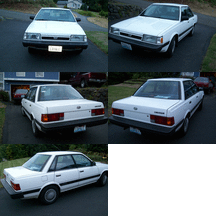
The blower motor has two connectors, a 4 wire and 2 wire. On my white car, the two wire male plug is toast. It overheated years ago and I have been wiggling and jiggling it to keep it going over the years. Saturday I went to the parts dept of Peninsula Subaru and was told that Subaru doesn't sell connectors. You have to buy the entire harness. I looked for Loyales at Row52 and it appears the j/y in our are do not have any Loyales. I really wanted to keep the original and all, but I am thinking I will just solder this up. It is a simple plug with a T connector. Didn't someone say one time that the older Toyota also used this blower motor? I wonder if Toyota would have that connector. Thoughts?
-
Have you tried removing the oil cap, starting it and put your hand (or hold a piece of paper over the top) over the oil filler to see if you feel air puffing out? If all you need is an air compressor, come over to my place. I also got a flexible camera to look in the cylinders.
-
-
-
-
Gone? Sold it? Scrapped it? It all looked so rose and now it is suddenly gone?
-
Do you recall how much it cost? I am seeing about $70 for third party.
-
Are third party coolant temperature sensors acceptable or are they garbage? Should I get the Subaru part? Ea82 spfi.
-
-
-
-
Though the original TRS-80 was a reference to the Zilog Z-80 processor upon which it was built, the later TRS80 Color computer (nicknamed CoCo) used the Motorola 6809 processor instructions set (similar to the Hitachi HD6301V1 in our Loyale ECU. ). Tandy Corporation decided not to change the name to exclude the original 80 reference. https://en.wikipedia.org/wiki/TRS-80_Color_Computer You can see the connection between the Hitachi 6301 and the Motorola 6800 below: The HD6301 was an 8-bit CPU designed using microcode to bring the simpler design techniques of 16 and 32 bit CPUs at the time down to 8-bit designs. Inspired by the Motorola 6800, the 6301 featured A and B accumulators, one stack and one index register. These, along with the PC, were mapped to a bank of sixteen 8-bit registers (R0L, R0H, R1L etc. up to R7H), which along with two data buffer registers (DBR and DBL), and memory address registers (MARL and MARH), were accessed by the microcode to execute the CPU instructions using one 8-bit ALU and a simpler 8-bit arithmatic unit. A simple 2-stage pipeline was used. - SOURCE: http://www.cpushack.com/CPU/cpu2.html How does the CPU control spark advance on the EA82 engine? I see nothing in the wiring diagrams to indicate this. Could you please explain?
-
-
How big is your protoboard? I know I can do a program to grab it if we can get the rest circuit done. But the we need to save the data off somewhere to make binary file that can be fed through the disassembler. I am thinking using the SCI on the chip to allow a serial connection to a pc and capture the data that way. I think there was example code in the handbook for this. This ain't no one nighters lol.
-
-
Looking at the note 2 on mode 0, it seems to indicate that you can briefly change the startup RES vector for testing purposes (eg verify the internal ROM using an external EEPROM). Once FFFE and FFFF are read, it must disconnect from the databus within 3-4 cycles to avoid driving the databus with more than one device. This is how an engineering sample would have been verified. If we wanted to read the internal ROM we would need to remove the 6301 from the board and put it in a mode 0 configuration on a protoboard that was setup to apply our custom vector to our own routine to read the internal ROM. The vector would have to point somewhere to one of the external memory spaces where a an EPROM is connected. We could develop the program without any hardware using an emulator, burn it to an EPROM that gets placed into available memory space on the protoboard. In order to redirect the RES vector we would need a circuit that would make our new vector available on the databus immediately upon RES and disconnect before 4 cycles.
-
-
I suspect this actually is data rather than code simply because it is not in the address space (eg mode7) but rather it is accessed by manipulation of the I/O pins which is what would normally be the address lines become in mode 7. There are four "ports" in Mode7, three eight bit and one 5 bit port, I will have to look at where the EPROM pins are going back (from your listing) to see which port it is using. I don't think that all 8K is data for a single model as I don't believe this early setup was that sophisticated. For example, you wouldn't need any tables relating to spark advance as there is a distributor etc. Really the main task is monitoring TPS, CTS and O2 sensor and adjusting the output waveform to one or more injectors. Because you have an 8K chip next to the 2K static RAM, I suspect there may be up to 4 "base maps" that could be loaded into static ram depending on the car options and heuristically adjusted. Perhaps the four maps are Carbed, SPFI, MPFI and MPFI Turbo? Did MPFI always mean turbo? Not sure. Of course this is all speculation. Our real challenge is to figure out how to read the internal masked ROM. I am thinking there has to be a way because when these were ordered, engineering samples were delivered for verification prior to a foundry production run. They had to have a way to verify the code was what was desired. If we can get that internal ROM read, we will be able to get something useful to disassemble.
-
-
IC 10 HA1835P https://www.digchip.com/datasheets/parts/datasheet/740/HA1835P.php The HA1835P and is a monolithic voltage regulator control designed for microcomputer systems. In addition to the voltage regulator, it include watchdog timer function and power-on reset function. These ICs can perform many function in various microcomputer systems with few external parts. https://www.digchip.com/datasheets/parts/datasheet/740/HA1835P-pdf.php
-
I believe that IC3, NEC D449C-1 is some sort of RAM chip based upon my discovery of a similar chip number : https://www.twistywristarcade.com/ram/1032-d449c-3.html I think I found the datasheet for this: https://www.digchip.com/datasheets/parts/datasheet/322/UPD449-pdf.php Based on the description above, I believe this is where trouble codes live while the car is turned off. There may be other goodies stuffed in there as well.
-
Let's start compiling a master chip list so we can at a glance associate a chip with a position on the pcb. I propose the following format: IC# Chip Number Description Datasheet link ------------------------------------------------------------------------------------------------------------- IC12 HD14013BP Dual D type flip flop http://www.harrisonelectronics.co.uk/datasheets/HD14013BP.pdf
-
Just had a thought. If it is in mode7, that means there is internal ROM that is most likely the kernal of sorts. If what ANIM_Hooneru said was true, it may mean that Subaru had a precursor to the SSM in the EA82 cars. I would expect that functions related to this would be on the internal ROM. If at some point we wish to read that internal ROM we could alter the board settings to a mode that would go to the EPROM and allow us to run some code piping the values out via the SCI as your EPROM reader is not able to read the internal ROM. Of course we would have to get some hardware built to do that. Potentially a data logger could be constructed at some future point using the SCI.
-
-
DaveT, In the assembly listing, the first things done are to clear locations 7F7F and 7F7A. I am thinking these are hardware control registers of some sort as I know hardware registers in general do exist as there are references to a "Rate Mode Register" for setting the baud rate on the Serial Communication Interface (SCI). This is built in functionality on the cpu itself. So if you happen to come across references to these addresses while reading, let us know. I wish this was a true PDF and not just scanned pages, the I could search the text. Anyway we could run this through an OCR progam to get searchable text?