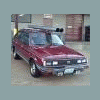
January 14, 20215 yr Heya, 1985 Brat 49 State, Hitachi carb. I replaced the Y pipe, which looked original (it had the air heater). It did not have an oxygen sensor. The replacement has one, and I wonder where in the wiring harness it connects.
January 15, 20215 yr It doesn't. It's not a feedback carb so it never had an O2 so there's nowhere to connect it. Just put a plug in the hole - buy a bung w/plug and just use the plug to seal it off. GD
January 15, 20215 yr Author Thank you GeneralDisorder! I plugged the hole with a sensor, I'll run a voltmeter off of it just for grins.
January 15, 20215 yr 18 hours ago, mkoch said: Thank you GeneralDisorder! I plugged the hole with a sensor, I'll run a voltmeter off of it just for grins. You’ll need to give it a power source to do that. You seem to enjoy odd things going by this... Cheers Bennie
January 16, 20215 yr Not true. A single wire narrow band sensor will create it's own 0-1v signal. It won't be useful in any real sense of the word, but it will not require power. GD Edited January 16, 20215 yr by GeneralDisorder
January 16, 20215 yr Well I just learned something! Doesn’t the ECU supply power or at least read the resistance voltage from the O2 sensor? Cheers Bennie
January 16, 20215 yr Author 10 hours ago, GeneralDisorder said: Not true. A single wire narrow band sensor will create it's own 0-1v signal. It won't be useful in any real sense of the word, but it will not require power. GD It should indicate that the engine is running lean, or rich, or in spec. How is this not useful? Edited January 16, 20215 yr by mkoch
January 16, 20215 yr It's a narrow band sensor. It only reads 14.7 AFR and has an EXTREMELY non-linear response. "Spec" and "Book" and all that nonsense is to be considered but only within the confines of what the manufacturer's motivations were for publishing it. First and foremost and in some respects the ONLY thing that mattered to them was Emissions. NOT Economy, NOT Performance, NOT NOT NOT. The FIRST rule of tuning - Give the engine what IT wants. It might idle nicely at 14.7 - but it might not. It might want a richer idle - especially if it's worn (likely at this age), or modified. It EASY to tune idle speed and mixture - you alternately adjust speed, mixture, and timing till you hone in on what the ENGINE wants - NOT what you want, NOT what the spec says, NOT what other people say it should be - NOT NOT NOT. Additionally - you won't be able to get any transitionary data from it - your DVOM is too slow and you aren't recording it - your pump shot and your WOT mixture will be WAY too rich to be anything meaningful on the narrow band sensor - it will just be 950 mV and then swing to 50 mV when you decel. It will be a useless swinging pendulum of meaningless data. Because the non-linear response of the sensor means at anything that isn't between 14.5 and 14.9 the readings change so rapidly with such tiny changes in mV that there's no resolution to the data and it's useless. The sensor was designed for a high speed computerized closed loop - wherein the computer responds by counting cross-counts through 0.5v and it is desirable for the mixture to "dither" above and below 14.7 in order to "charge" the catalyst. The computer only cares about the sensor telling to add fuel or subtract fuel - in a dance it calls closed loop. This results in the dithering behavior and is by design. The narrow band sensor was designed SPECIFICALLY for this purpose - to facilitate closed loop operation by computer. It was NOT designed to be a tuning tool. That's what Wideband Sensors are for. GD
January 16, 20215 yr 8 hours ago, el_freddo said: Well I just learned something! Doesn’t the ECU supply power or at least read the resistance voltage from the O2 sensor? Cheers Bennie Nope. The sensor generates a voltage input to the computer via a single wire. You can read this voltage with any meter. But the data is useless as I explained above. GD

Please sign in to comment
You will be able to leave a comment after signing in
Sign In Now