porcupine73
Members
-
Joined
-
Last visited
Everything posted by porcupine73
-
porcupine73 replied to mdjdc's topic in 1990 to Present Legacy, Impreza, Outback, Forester, Baja, WRX&WrxSTI, SVXRight on. The '96 rad should have the bleeder. The later style Subaru rad's that have the block outlet to the rad kind of in the center top of the rad don't have a bleed plug. There are lots of ways to refill the coolant without trapping air bubbles. I've been using the vacuum fill method, but there are several other methods.
-
porcupine73 replied to legacyak's topic in 1990 to Present Legacy, Impreza, Outback, Forester, Baja, WRX&WrxSTI, SVXDoes the Mobil1 stuff have anything to do with the pre/post Katrina formulations? I recall after hurricane Katrina (granted that was a few years back now) that some blenders were having trouble getting the basestocks they needed and many suppliers were putting their customers on allocation.
-
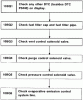
Hi. P1443 is a manufacturer/model specific code (not like the generic P0nnn codes). That might be why they told you they needed a special tool. What brand injector cleaner did you use? The closest manual I have is for an '00obw, which says DTC P1443 - EVAPORATIVE EMISSION CONTROL SYSTEM VENT CONTROL FUNCTION PROBLEM DTC DETECTING CONDITION: Immediately after fault occurrence TROUBLE SYMPTOM: Improper fuel supply The procedure has you check all the vent lines and hoses associated with the charcoal canister, including: Clogging of vent hoses between canister and drain valve Clogging of vent hose between drain valve and air filter Clogging of drain filter If that's good, it has you connect the test mode connectors under the dash and verify operation of the canister vent valve. If the vent valve is not operating, it has you replace it. The SELECT monitor can also be used to test the drain valve, that would be another special tool they might have been saying was needed.
-
Hi. If you are planning to just have the boot replaced (as opposed to having a Subaru or MWE reman axle installed), then I would not drive it until the boot is replaced. Otherwise additional grit and dirt may get into the joint. The RH (pass) inner boot is not uncommon to tear since it's right near an exhaust member. The OEM boot quality is known and seems to be pretty good. If you must drive it before having the boot replaced, it wouldn't be too bad on clean dry roads. If you drive in rain or dusty conditions then the risk of grit/dirt in there increases.
-
porcupine73 replied to 211's topic in 1990 to Present Legacy, Impreza, Outback, Forester, Baja, WRX&WrxSTI, SVXI double checked this morning. I removed the coin slot/fuse cover below the cruise/fog/etc buttons. Then I reached up into that opening and pushed out the buttons from behind.
-
porcupine73 replied to 211's topic in 1990 to Present Legacy, Impreza, Outback, Forester, Baja, WRX&WrxSTI, SVXHi I have an '00obw too. What I did is reach up in behind the dash and push the buttons out. Didn't have to remove the woodgrain trim or anything.
-
porcupine73 replied to CPAScott's topic in 1990 to Present Legacy, Impreza, Outback, Forester, Baja, WRX&WrxSTI, SVXI would not buy the extra warranty. Some people like the peace of mind and if you view it as insurance that you may not need then that's fine. On any such warranty, the details must be checked carefully. Especially things that are not covered. Like let's say your drain plug comes loose, dumps the engine oil, and damages the engine. The warranty might cover the cost of new engine oil, but not the cost of engine repairs.
-
porcupine73 replied to ericem's topic in 1990 to Present Legacy, Impreza, Outback, Forester, Baja, WRX&WrxSTI, SVXTypically yes you need a band clamp. Lisle makes a couple. There are some gm and other manuf specific types, and some use a ratchet. Also check out Band-It they make all kinds of tools and clamps for lots of applications including cv boots. If you didn't buy the cv joint boot kit (which includes the grease), then you need cv joint grease. Redline cv-2 could be a good choice. Regular wheel bearing grease is not pure/refined enough for cv use.
-
porcupine73 replied to pulloff's topic in 1990 to Present Legacy, Impreza, Outback, Forester, Baja, WRX&WrxSTI, SVXHere's pretty much what you'll see if you remove the RH access cover in the rear:
-
porcupine73 replied to Petersubaru's topic in 1990 to Present Legacy, Impreza, Outback, Forester, Baja, WRX&WrxSTI, SVXThe drain plugs are magnetic. I know the phase I 4EAT does have the magnet in the pan as well. Not sure about the phase II, but it probably does. The phase II, which started in ~99MY has the external filter. (Earlier phase I 4eats did not, unless they had the Subaru filter kit installed).
-
porcupine73 replied to pulloff's topic in 1990 to Present Legacy, Impreza, Outback, Forester, Baja, WRX&WrxSTI, SVXHello. P0440 could be anything that is letting pressure out the fuel system, such as faulty/loose gas cap, etc. In our salt laden winters (rural WNY here too!) sometimes the fuel filler pipe rusts out and causes this problem. For parts, you might check out those big salvage yards over on William St. I've never gone in but they might have something. Also Skyway auto parts might have something, I think they're near that Tifft preserve.
-
porcupine73 replied to legacyak's topic in 1990 to Present Legacy, Impreza, Outback, Forester, Baja, WRX&WrxSTI, SVXIf you ask 10 different people what oil you should be using, you'll get 15 different responses. 10W30 is fine. Earlier Subaru's used to say 5W30 was not recommended for sustained high speed driving or something like that. I've run synthetics in weights from 5w30 to 20w50 with no issues. Many automakers are now suggesting lighter weight oils for increased fuel economy and sometimes cafe, though since many subaru's classify as a light truck or something for cafe it's not as big a deal for them.
-
porcupine73 replied to Hondasucks's topic in 1990 to Present Legacy, Impreza, Outback, Forester, Baja, WRX&WrxSTI, SVXHm..do you remember the name of the justice bros package? I'd never heard of them, but they have a wide range of products on their web site.
-
porcupine73 replied to s'ko's topic in 1990 to Present Legacy, Impreza, Outback, Forester, Baja, WRX&WrxSTI, SVXThere was that post some months back from someone who put an old Mercedes I think it was supercharger and fed that into a turbo on a Legacy I think it was...
-
porcupine73 replied to uniberp's topic in 1990 to Present Legacy, Impreza, Outback, Forester, Baja, WRX&WrxSTI, SVXFive watts isn't a whole lot; many nightlight bulbs are seven watts or so. It does have to be able to carry the 100 amps or so. Also under average conditions maybe the vehicle is drawing what maybe 30 amps or something when running. Of course high loads such as lights, defrost, power windows, etc all add to it. The CT's I'm thinking of want to output a current on their secondary proportional to the current flowing through the primary. The CT's are usually rated like 75:1 or 200:1 or whatever, so 75 amps flowing through the wire the CT is around results in 1 amp flow through the secondary. If the CT secondary is disconnected, it still wants the current to flow. The resistance is basically infinite, and since V=(I)®, you can see the voltage becomes very high. The limiting factor is usually the insulation in the windings; maybe it can handle 5kv or 10kv or whatever.
-
porcupine73 replied to RedRum's topic in 1990 to Present Legacy, Impreza, Outback, Forester, Baja, WRX&WrxSTI, SVXThere could be. I believe Subaru has said the H6 filter may be used on the H4 engine, and it does have more filter media surface area. But the H4 filter may not be used on the H6. It is in an EndWrench article. I wonder what filter the new H6 for the '08 Tribeca will take. That is like 6+ quart oil sump capacity I think I read.
-
porcupine73 replied to nipper's topic in 1990 to Present Legacy, Impreza, Outback, Forester, Baja, WRX&WrxSTI, SVXIt really depends on what you want/like. If you like a little firmer ride, you'll like GR-2's. If you're the kind of person who likes that soft, absorbing (which I think feels sloppy) kind of ride, then you may not like GR-2's. Just put KYB GR-2's on '00obw, plus king springs. Yes the ride is stiffer (firmer) than it was before. But that's the way I like it. It seems to handle better that way, especially in bumpy situations like over railroad tracks and such.
-
porcupine73 replied to uniberp's topic in 1990 to Present Legacy, Impreza, Outback, Forester, Baja, WRX&WrxSTI, SVXIf the shunt were to short, no worries; the gauge would just read 0. If the shunt fails open, that could fry/damage the gauge. A very low milliamp fuse inline with the gauge wiring might pop it then if the shunt fails open. The power dissipated by the shunt at 100amps, 50mV would be five watts. Yes the dakota digital gauge you showed does have a nice setup. That is the CT (current transformer) sensing method. The current induced in the CT is proportional to the current flowing through the wire. These are very common in industrial equipment where you might want to measure 1000Amps or even more. The only risk I know with CT's is that the secondary CANNOT be operated open circuit. It will probably damage the CT and can present electrocution hazard. The secondary voltage will climb to thousands of volts if current flows through the CT with its secondary circuit open. If it needs to be disconnected, the secondary should be shorted. This is a common safety issue in industrial equipment.
-
porcupine73 replied to uniberp's topic in 1990 to Present Legacy, Impreza, Outback, Forester, Baja, WRX&WrxSTI, SVXMany vehicle ammeters have a 'shunt' (resistor) that you place inline with the load you want to measure. Then just minimal gauge wiring runs from the shunt to the gauge. If you get a meter that is 50mV at FS (full scale), and you want it to read full scale at 100 amps for example, you would get a 50mV/100Amp shunt = .0005 ohms Or if you get the cheapest multimeter you can find that you can get a clamp on ammeter probe for that might be an option.
-
porcupine73 replied to njdrsubaru's topic in 1990 to Present Legacy, Impreza, Outback, Forester, Baja, WRX&WrxSTI, SVXHi. With the pin knocked out, can you push and pull the axle joint in and out on the diff stub shaft? It should give you an inch or more of play. If it does not move, you'll have to free it up with some penetrating oil, maybe some hammer tapping, etc. If you pry, lever the pry bar off one of the bolts on the diff. Do not lever off any other metal parts because they can crack. It won't move enough to slip it off the stub shaft without loosening/removing some fasteners at the wheel end. I just completed this job on '00obw and have pictures and video, just haven't had a chance to write it up yet. edrach's write up is what I referenced and it went smoothly. I removed the strut to knuckle bolts to get my clearance. If you do it this way, pay attention to the brake flex hose so as not to pull on it excessively.
-
porcupine73 replied to ericem's topic in 1990 to Present Legacy, Impreza, Outback, Forester, Baja, WRX&WrxSTI, SVXYep that was the article nipper. Excerpt:
-
porcupine73 replied to ericem's topic in 1990 to Present Legacy, Impreza, Outback, Forester, Baja, WRX&WrxSTI, SVXI did the stoptech bed in; seemed to work well. The way they described the bed in would go was how it went also. The stoptech bedin is probably a little agressive for the stock pads but it still worked. There was an EndWrench article that basically said bedding in was not required and is antiquated; can try to find if interested.
-
porcupine73 replied to legacyak's topic in 1990 to Present Legacy, Impreza, Outback, Forester, Baja, WRX&WrxSTI, SVXBest guess is P0420. The only way to know is to get it read. Excellent..another '00obw owner
-
porcupine73 replied to sgtschultz's topic in 1990 to Present Legacy, Impreza, Outback, Forester, Baja, WRX&WrxSTI, SVXWhat's your location?
-
porcupine73 replied to eryque's topic in 1990 to Present Legacy, Impreza, Outback, Forester, Baja, WRX&WrxSTI, SVXHi. Maximum power split is 50% power to the rear wheels. There are some STI transmissions that can put more than 50% power to the rear. Other than those certain STI trans's, the front wheels always have power; they are directly driven off the transmission. The trans can vary the amount of power applied to the rear wheels. So if it detects front wheel slippage, more power is directed to the rear wheels. If rear wheel slippage is detected, less power is directed to the rear wheels. This is a basic description; the mechanics are different for AT's and MT's. When there is no slip detected, in the AT's anyway, the power split is controlled by a map. Side to side traction differences depend on the differential type you have and whether or not you have TCS. The normal is the open diff, where one wheel can sit there and spin and the other won't turn. Unless you have a limited slip diff or locking diff. If you have TCS, the system can use the ABS pump to apply the brake a little bit to the wheel that is slipping thus giving more power to the wheel with traction.