idosubaru
Members
-
Joined
-
Last visited
Everything posted by idosubaru
-
idosubaru replied to Fairtax4me's topic in 1990 to Present Legacy, Impreza, Outback, Forester, Baja, WRX&WrxSTI, SVXthey probably used low grade gaskets. or they didn't clean/prep the surfaces very well or used a poor torque procedure (if they used one at all). i can almost view this two different ways: A. it was such a poorly maintained car, it's probably got some damage somewhere that will creep up later in the form of bearing woes. or B. the repair was so bad that the car wasn't even drivable to the extent that it caused any damage so you've got a great long block to properly reseal?! seems like it may have had a minimal leak, poorly attempted repair - and not driven much? which do you see?
-
idosubaru replied to whynot's topic in 1990 to Present Legacy, Impreza, Outback, Forester, Baja, WRX&WrxSTI, SVXbearings aren't cheap, machine shop work isn't cheap, checking clearances, over or undersizing - it just gets labor, parts, and $$$ intensive. main bearings, rod bearings, piston rings, honing. people do it, it's not necessarily difficult, typical bolts and engine stuff, nothing complicated or abnormal. I've always wondered why can't you take a nominal block with no current issues, otherwise unknown, and install new rod and main bearings?.
-
idosubaru replied to imo's topic in 1990 to Present Legacy, Impreza, Outback, Forester, Baja, WRX&WrxSTI, SVXpull it with another vehicle and a long chain in neutral. i do it in the middle of the night when they're no traffic. if it at least idles, let it idle whlie you're towing it so you have brakes, steering, and nominal operation/fluid movement.
-
idosubaru replied to whynot's topic in 1990 to Present Legacy, Impreza, Outback, Forester, Baja, WRX&WrxSTI, SVXseverly overheated engine are prone to loose rod and main bearings in the future. there's no way to verify or tell though. the heat cyling ruins the bearings and oil supply. so it sort of depends - if you dont' mind doing that labor for what might end up as a boat anchor by years end, have at it. if you can do a little discerning - like have an idea how badly it was overheated - that can help you gauge risk. if it's as bad as it sounds - overheats immediately like this - i'd guess it was severely overheated and i wouldn't want that block myself, but i'm picky and if i spend time on an engine it better have a very good chance at 100,000 more reliable miles without coming out again. theoretically you could mail the oil off to an oil analysis place and see if there's metal/bearing material in it - but that's not perfect and has downsides too. in general very few people split subaru blocks but a few folks do it.
-
idosubaru replied to trainergames's topic in 1990 to Present Legacy, Impreza, Outback, Forester, Baja, WRX&WrxSTI, SVXwhile turning - jerking/thunking - now we're getting somewhere. that's a lot different than "making noises". it does sound like torque bind. you can search the forum for that word and find all about it. installing the FWD fuse may or may not alleviate it, start there. if it is torque bind change the fluid immediately, like 3 drain and refills.
-
idosubaru replied to joomanburning's topic in 1990 to Present Legacy, Impreza, Outback, Forester, Baja, WRX&WrxSTI, SVXwoah nice. last one i pulled apart i couldnt' tell which were bent and which were not, so i just replaced them all. looks like you didn't have that problem!
-
correct - sort of. it just depends what you want. what are you trying to do - exactly, be honest and specific? You want the car to actually be fast, sound cool, look cool, spend the weekends DIYing some things...what? if you want a little bump - get some delta cams, lighten the car, give it a good tune up, open up the exhaust a tiny bit, delete the A/C, power steering belt, lower the car, play with wheel/tire sizes, and you're good to go. that's about the most you can easily do. if it's to "be fast" - you're out of luck. it's 98 HP and NA - no chance, they have atrocious 1/4 mile times. and by the laws of physics, NA engines don't respond to performance upgrades like forced induction engines do. so if yo'ure unfamiliar with cars (some people are, no offense meant, i have no idea), you can't just bolt on things and get massive improvements like you can on turbo vehicles - it's just simply based on physics and mathematics, it's not possible. if you want looks, bling bling and easy to buy novelty parts - subaru is a small company and businesses don't make parts for them, particularly older generation stuff. if you want it to be like "show up to store, buy something, bolt it on in 30 minutes" - then yes, as I said Subaru is a small player, limited market.
-
idosubaru replied to whynot's topic in 1990 to Present Legacy, Impreza, Outback, Forester, Baja, WRX&WrxSTI, SVXprobably is partially time of year. patience is very helpful. as soon as you commit to a B grade vehicle you'll see 9 A grade ones in the coming weeks. if someone said it was the rear diff - it wasn't. they're misdiagnosed all the time, very very common. it's usually wheel bearing, torque bind (center diff), or driveshaft ujoints.
-
idosubaru replied to 500Stroker's topic in 1990 to Present Legacy, Impreza, Outback, Forester, Baja, WRX&WrxSTI, SVXPiston slap? doesn't sound like it. It should take longer than "a few seconds" to quiet down and you seem confident it's in the heads, but piston slap quiets down as the engine warms up.
-
a guy on subaruxt.com documented some changes and I don't think he actually got any gains out of intake improvements, and i think that's usually how it goes. but he was after driving performance, not audio performance, so if you just want to hear it, then have at it. custom fit silicone pipes, get a MAF adapter, and go to town. I think his biggest documented gains were - like 7hp I think in his XT6 (with 145 hp stock), so that's a 5% increase, by advancing timing and running premium gas. by extrapolating that to the 4 cylinder (same pistons, valves, basic design) you might get 5 hp that way.
-
idosubaru replied to joomanburning's topic in 1990 to Present Legacy, Impreza, Outback, Forester, Baja, WRX&WrxSTI, SVXI'm unfamiliar with the EJ22 heads but you're probably right - they're the same intake manifold, same valves, basically the same exact heads except for the single port exhaust, so yeah you're probably right, the Phase II heads may be identical. Phase I heads won't accept the Phase II intake manifold so you can't bolt the Phase I heads up without annoying issues to resolved, customize, work around.
-
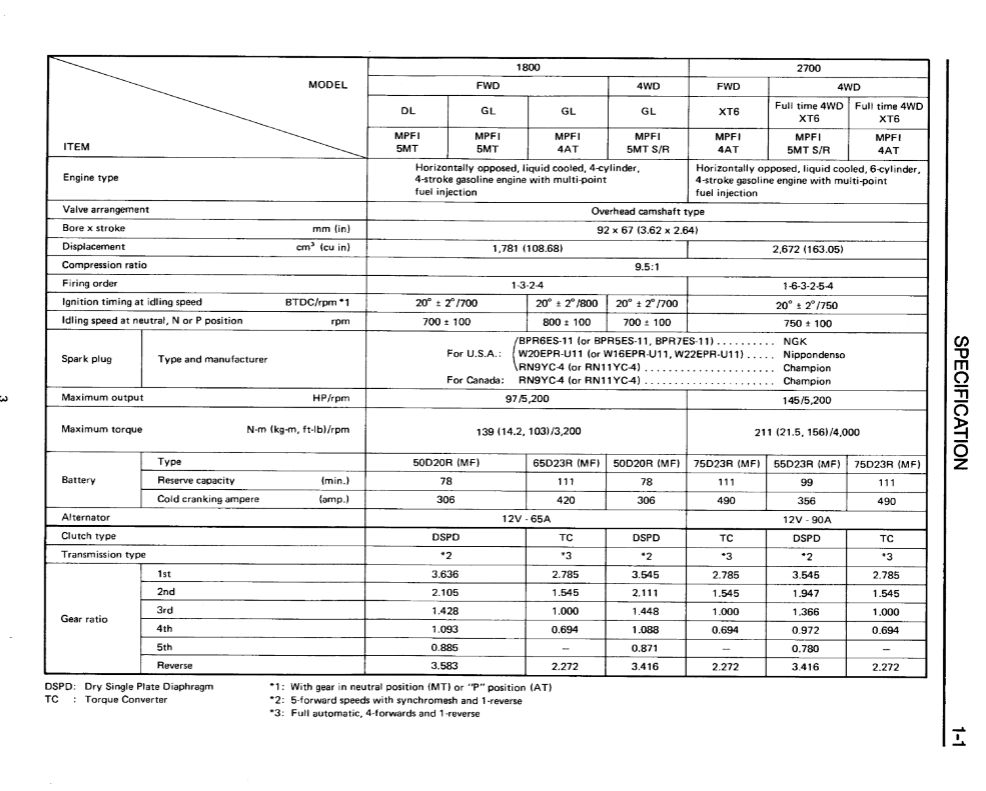
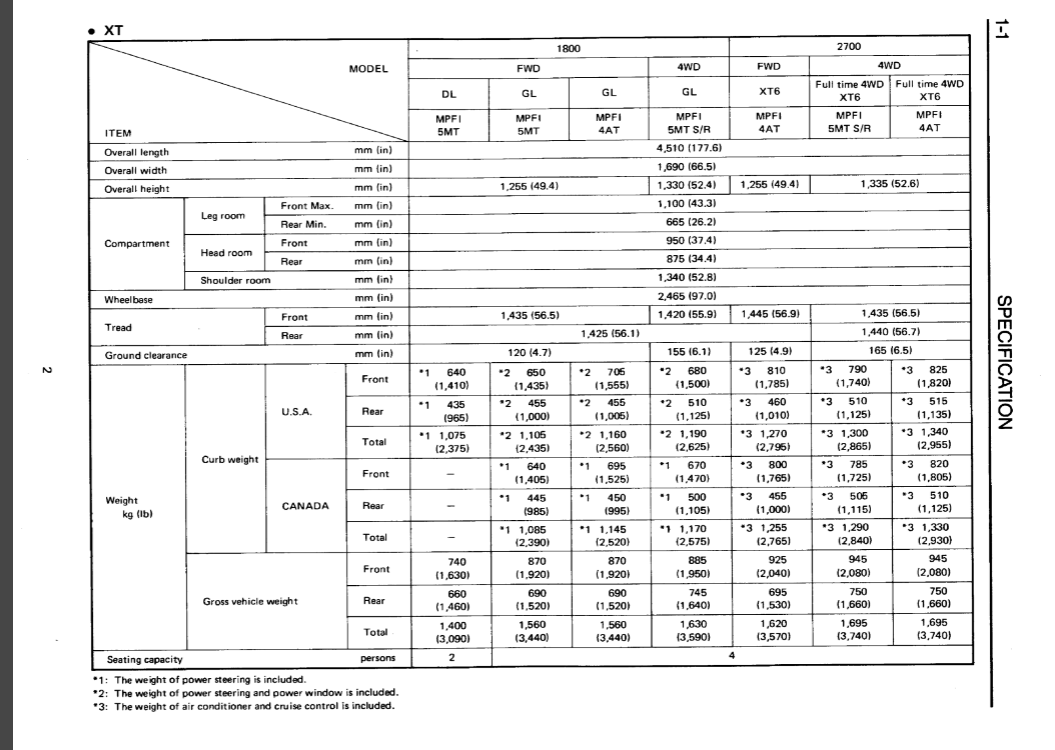
1988 XT6 automatic is 98.14 hp/ton 105.58 tq/ton
-
Chux is letting this site expire so it's about to be unavailable but he's got some older stuff here. EA82 should cover somewhere around 1985-1992 stuff: http://www.numbchuxconversions.com/Files/FSMs/ I attached the 2 pages for 1988 XT weight and power/torque for the various offerings: 4WD, 2WD, auto, manual, 4 & 6 cylinder:
-
idosubaru replied to trainergames's topic in 1990 to Present Legacy, Impreza, Outback, Forester, Baja, WRX&WrxSTI, SVXYou should describe the symptoms exactly instead of ask "what are the symptoms of XYZ". Or if you have a compelling technical/mechanical reason to think you're hunch is correct - tell us why. Yours doesn't sound like a center diff issue as sound is not a typical initial failure symptom. Have yourself or someone stand outside the vehicle on the left/right or ride in the drivesr and passengers seat. If the noise is notably left/right it's wheel bearing or CV axle depending what you're troubleshooting. If it's notably center/back, it's something else.
-
idosubaru replied to joomanburning's topic in 1990 to Present Legacy, Impreza, Outback, Forester, Baja, WRX&WrxSTI, SVXSOHC forester EJ25 and 99 OBS EJ22 are essentially the same engine. Can swap blocks, can swap heads, can swap engines, intakes. The valves are the same part numbers between the two. You could bolt the EJ22 heads right to the forester block and be good to go and I believe that uos compression for even more cowbell. OBS hS single port heads and exhaust manifold. There are two style trigger marks used for the crank sprocket and drivers side cam sprocket. Keep those with the ECU. In other words - install those OBS sprockets on the Forster engine. Or just look at the trigger points, it's really obvious one has a ton of triggers the other just a couple. If they're the same then no worries. I believe it's an auto/manual difference. Steering suspension driveline (though different final drive ratios) are all interchangeable as well. Brakes are likely different but interchangeable. Not sure you ever mentioned the year of the Forster so we're sort of guessing it's not a 2015. Lol!
-
idosubaru replied to whynot's topic in 1990 to Present Legacy, Impreza, Outback, Forester, Baja, WRX&WrxSTI, SVXThat's the way to go headgasket needing ones are a dime a dozen, Subaru rear diff failure is so rare you're not going to find one for sale.
-
idosubaru replied to brentlysubaru's topic in 1990 to Present Legacy, Impreza, Outback, Forester, Baja, WRX&WrxSTI, SVXit still only does it while turning left? did you install the FWD fuse to see if the binding goes away? that one directional bit does sound odd, but i'd still guess torque bind first before the diff just based on the words i'm reading (i realize in person can be more convincing). drivetrains typically have slop, so turning before catching is normal. of course there's limits but it would need some compelling play to be diagnosable.
-
idosubaru replied to mrpeabody56's topic in 1990 to Present Legacy, Impreza, Outback, Forester, Baja, WRX&WrxSTI, SVXyep, same bleeding as any other subaru in the past 30+ years.
-
idosubaru replied to brentlysubaru's topic in 1990 to Present Legacy, Impreza, Outback, Forester, Baja, WRX&WrxSTI, SVXothers have install the 00-04 diffs in 95-99 legacy/outbacks without issues. are you sure? that's usually a misdiagnosis and incorrect. subaru rear diffs rarely fail. every "failing rear diff" i've seen ended up being something else. car i just bought was like that - was told it was the rear diff, it wasn't.
-
idosubaru replied to whynot's topic in 1990 to Present Legacy, Impreza, Outback, Forester, Baja, WRX&WrxSTI, SVXI'm assuming you mean *final drive ratio* of the front and rear diff? (your title says "axle" and second sentence says "gear ratio" which implies transmission?) If you're talking about the 1999 Outback in your sig - then your final drive ratio is the same as all 1996-1999 Automatic EJ25 legacy/outbacks. There are different final drive ratios even amongst automatics and manuals: No EJ22 (or EJ18) vehicles have 4.44 final drive of the outback. EJ22's/EJ18's are 4.11 and 3.9. Automatic Phase I EJ25's have 4.44 final drive ratios. Manual Phase I EJ25's have 4.11 final drive ratios.
-
idosubaru replied to potter2010's topic in 1990 to Present Legacy, Impreza, Outback, Forester, Baja, WRX&WrxSTI, SVXJust crawl under the car, can't miss them. look for the mounts that hold the engine - then look where they sit on the cross member - right under there are the engine mount nuts, as said they can often be close to vertically above the exaust routing. can't see a 2010 being an issue but in general if the vehicles sees rust prone environments a 6 point, preferably deep well socket is a good idea. some sockets are short and don't fully seat on the nut due to the stud....again, not gonna matter on a 2010... google search of Subaru engine mount nuts brings up a bunch. Key note is that Subaru engine mount nuts haven't ever changed in principle for like 40 years so if you know one, you know them all: https://www.google.com/search?q=subaru+engine+mount+nut&espv=2&biw=1242&bih=602&source=lnms&tbm=isch&sa=X&ved=0ahUKEwi4u4Ou1qrQAhXDSSYKHdqlAp4Q_AUIBygC#imgrc=_
-
nifty. I almost understand that but get a little lost with wording....series, wire pair, interrupt, control switch, flasher relay - those words have some ambiguity for me, i'm like middle school electrically....
-
idosubaru replied to Dpmason89's topic in 1990 to Present Legacy, Impreza, Outback, Forester, Baja, WRX&WrxSTI, SVXaftermarket axles are always suspect even if they're new, particularly if it's a lifted vehicle. what vehicle? is it lifted? what do you mean by "blowing out"? just the boots, inner joint, outer joint or vibration, noise, or actually blowing to pieces with balls rolling all under the car? if it's just the boots - replace them with Subaru or a decent brand. I have two EA82 axles if you wanted to make an offer - not sure shipping makes it worth our time though.
-
"on the back" - i assume you mean the parking brake cover like DaveT mentioned. they are massively saturated in grease usually, so should be protected for awhile, I assume you can just get a used boot and swap it out. not sure you can buy those new, rockauto sometimes has oddball brake components like that. plenty of us on here have calipers lying around and could send you the boot probably?, post in the parts wanted forum.
-
idosubaru replied to axgutt's topic in 1990 to Present Legacy, Impreza, Outback, Forester, Baja, WRX&WrxSTI, SVXThey don't fail very often if you want to have someone send you a used one. get two and keep one in the trunk if you're worried about it failing again, but they're not common issues.