DaveT
Members
-
Joined
-
Last visited
Everything posted by DaveT
-
I stumbled across something in my FSM whilr.looking for something else, that might explain the 7 vs 8. The FSM list showed a 7 vs 8 depending on 49 state vs CA.
-
There is a thread somewhere about fronts, that even had pictures and part numbers for replacement 4WD style fronts. I got a pair with the info. Too long ago to remeber now the details.
-
IF the FPCU was powered while wet, especially with water that came through a rusty area, it will need to be cleaned washed and dried before it can even be troubleshot. water with ions conducts. If there was voltage between 2 pins for any length of time, corrosion [electrolysis] happens. Not in minutes, but longer = worse. Even without power, the contamination could cause malfunction. Bypass for testing, for sure. It is good to have something kill the fuel pump in the event of an accident that shuts down the engine.
-
"Crank angle sensor" is the distributor / pickup that on an older car would have been the points. 12 has nothing to do with your trouble. 61 probably not. I've never seen this code. Weird idle problems i have seen with NO codes - failing CTS - coolant temperature sensor - the 2 wire sensor on the lower thermostat housing. This can cause all kinds of weird drivability problems, as the fuel mix isn't correct for the engine temperature. Broken wire to the IAC valve, or dead / stuck IAC valve. idle air control valve. If this is the problem, you can maintain idle with careful application of the gas pedal, and still drive. The fusible link burning up is odd. A short in the alternator output could burn it out. All of the other loads on that link are fused at much lower amps, so those fuses should blow before the link. Other possibility, is alternator output totally out of control, pushing out full power - but I've not had the link burn out from that, just over voltage, which I regulated by turning on and off accessories to avoid frying electronics and the battery until I got home.
-
I would need a factory service manual schematic to try to troubleshoot. I only have 86 and up.
-
The bearing should be replaceable. Not a bad idea to get a part number off of it now. If getting back on the road quick is an issue, get a spare.
-
The original older OEM 4WD struts have nuts on them that let you adjust the height about 1" At some point, they dropped them. 2WD are fixed at the low height.
-
Don't know if I can find a part number. There were 2 variants of A/C I am aware of, if it is an EA82 engine. One, the compressor is closest to the battery, the other, the alternator is closest to the battery.
-
Yeah, we are just going to have to get more creative to keep these old ones running as time goes by.
-
You might have better luck in the newer forum, since what you are dealing with is an EJ engine problem. It probably has little to do with the body it is installed in. Outside of checking all the wiring involved with fuel and the throttle body, I can't say much else. I've never had an EJ.
-
Starting to seem like a common 30yr old part to fail...
-
I have a dual range transmission that needs a home.
-
Yes, but the heat will expand the bolt, more than the hole in the crank, making it tighter. While making the bolt weaker. When I've most often used the torch method successfully, it's when heating the "nut" side of things. In this situation, the nut expands more than the bolt, making a looser fit. Not identical to this situation - I have found that especially when dealing with steel bolts in an aluminum block, getting the engine up to normal operating temperature before trying to loosen the bolts helps a LOT. I've gotten many out that would have snapped if attempted at room temperature. If the engine can run, that's the quickest way, but a few times, I used a space heater and a heat gun, while watching a thermometer in contact with the area near the bolt.
-
That should hold it, just feather those valves carefully...
-
There is only one fuel pressure regulator, it is held onto the throttle body by 2 screws. The only thing I can guess you may be misidentifying are the dampers - they smooth pulses / surges in the pressure. There is one on each line under the hood, and one on the OEM fuel pump. Good to know, about the adjustable ones. They go inline? Then I just have to figure out how to make the dead stock one go full open?
-
I would not get a it past normal operating temperature, 190 degrees F. That's working against the problem anyway. 3/4" drive socket from McMastercarr.com or mscdirect.com and a breaker bar. And a pipe.
-
Is the choke closed when it's cold? From one of the earlier posts, you said it was pouring fuel into the intake? It's badly flooded. It takes a long time to clear that. Give it a 2 second shot of carburetor cleaner in the primary, holding the throttle open. Then go give it a crank, holding the gas pedal about half way down. If it fires momentarily, you know everything is ok except lack of fuel / or mix.
-
hmmmm.... Well, I probably should investigate what is wrong with the bad regulator, and figure out what to do to fix it. Since I have no doubt that they are NLA, since the fuel pumps are NLA. Other thing to note - The stock pump draws less than 1.5Amps, and the Carter P5000 draws a hair over 5Amps.
-
OK! I replaced the fuel pressure regulator. I have a spare SPFI manifold I traded for the carburetor one I had on my 86 GL. Took the regulator off that spare one, which looks like it wasn't very old / low miles /indoors most of it's life. Car fired right up. Pressure nice and steady, at 24PSI - which is a little high. Drive to the bottom of my safest "test" hill. Checked the vacuum line to the bottom of the pressure regulator, oops, I left it off. Connected. Pressure more normal 22PSI. Still nice and steady. Drive up the hill, NO PROBLEM! Loop around for another test, and no problem. Took a run up the steeper bigger higher speed hill nearby, and no problem. Pressure now at 20PSI, but it is running fine as it always has.
-
Just for the information, the risk in using the old existing wire is that it is not sized for the higher output of the modern alternator. The stock fusible link should cover most failure modes ok, but not allow the full use of the higher output.
-
On the back / side of the starter is a single wire, tat triggers the solenoid. Use a test lead or piece of wire to get 12v to this terminal. If it cranks, the problem is high resistance in the circuit feeding it. The "relay mod" is the easiest way to fix this. If the starter clicks, but does not crank the engine, the contacts need to be replaced.
-
Hydrocarbons = running rich. Too rich for emmisions, but not enough to screw up drivability, which takes more. The catalytic converters are involved with hydrocarbons and no. How did they test it? As an 83 or what is expected of an EJ? Probably good to read the codes, since the ecu should give a clue about the rich condition.
-
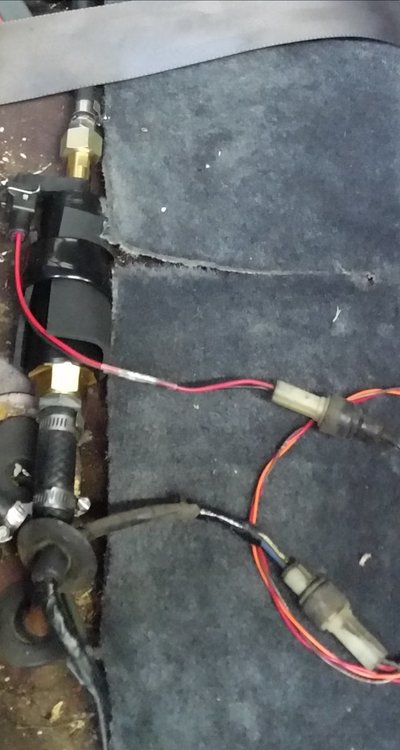
Test run done. It's not the fuel pump. Last night, I ran the new pump, pressure looked good,etc. Today, I started the car and the pressure was bopping up and down again, 20 to 22 PSI. Ran great and normal, until I got it warm and decided to take the bigger risk of a main road with a steep uphill grade, when the sputtering began under load. Made it home ok at least. Debating next move... Swap the pressure regulator, or the injector? I installed the Carter P5000 in the space between the rear set and the floor, so it is not in the weather.
-
I should have a chance to get a test run in over this weekend. The only thing left to do now is solder the 2 wire from an old Subaru connector to the new Carter connector. A whole list of other things going on has been making my progress on this a bit slower than typical.
-
I got a Carter P5000.