
DaveT
Members
-
Joined
-
Last visited
Everything posted by DaveT
-
They should be 10 x 1.25. My 76 had the same size as my Loyale / EA82s. They screw into the head about 1/2 inch, maybe a little more. The studs I have are about 1 3/4 " long. I've seen slightly shorter & longer ones.
-
4WD solenoid. Wires go to the 4WD button.
-
Timing belt Idlers & tensioner too.
-
Not stupid. We need to find someone familiar with the chemistry of fuels. Definitely a project for a separate shed w/ventilation & shade.
-
I recently got a 2 row from http://www.usaradiator.com All metal, not made in China. I did have to modify the bottom pins - I don't know if I got "lucky" with a slightly out of spec radiator, or the car frame is off, but a little grinding & TIG fixed it. I had a bad experience with one of the $120+- radiators the seller, actually. The one with the fake online "chat". I specifically asked for all metal 2 row with the return port angle up, they sent a plastic cap 1 row return port straight. I had to drive over 30 miles round trip to return it, and the jerk didn't want to refund, only swap me another crap plastic cap 1 row radiator. I was livid, and the guy even implied that I had ordered the wrong one! The lowest price isn't always the best deal.
-
R-12 is the original. There are conversion kits, I never used one. eBay.
-
They are hidden by the plastic trim I have / had an 86, 87, 88, 90, 92. All have gutters under the trim.
-
This sounds tricky, here are few things that come to mind: I'm thinking most likley is the alternator or regulator. Check for bad ground - connect one meter lead to the case of the alt. the other to the battery -. You should only see a small voltage. Try different load / no load / engine on / off. The mystery voltage on the stereo power lead could be leakage from a control line - on / off or clock? Or if it has a large capacitor on the input, it would hold a couple volts for quite a while with only a meter connected. I'm guessing the battery is ok - It cranks the engine, has normal (slightly high) resting voltage. A good flooded cell battery ranges from 12.0V (full discharge) top 12.6V (full charge) AFTER sitting for a number of hours with no loads. The Optima is a starved electrolyte cell, so the exact numbers might be a little different. To measure high current you need a shunt. Cheap way: get a length of wire - like 12" of #10 or #8. Look up the ohms per 1000 feet. Do a little math to figure out how many ohms you have. Connect the wire in series with the circuit to measure, connect your VOLT meter across the measured lenght of the wire. Ohm's law to get the current. As long as the shunt wire does not get warm, the reading will be accurate enough. Middle cost way. Find a surplus .001 ohm 1KW resistor. It works very nice for this. I got the one I have a very long time ago, so I have no idea where to get another, unfortunately. Google/ebay?? Expensive way: $2000.00 Tektronix current probe. clips right onto the existing wire. Disable / remove fuses from all circuits not needed to run the engine, see if anything is causeing weird loading? Swap the alt / battery from another car?
-
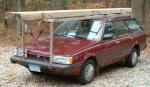
I have hauled at various times, not all together: 4 pcs 4x12 sheetrock. 3 boxes vinyl siding. 4x8 plywood. 6-8 pcs 4x8 sheeetrock. 24 pcs 4x8 foam insulation board - sandwiched with 1/2ply so it doesn't crush. various 2x framing wood, up to 20' long. 21' lengths of pipe. 12' long extension ladder. all of the 5'x9' rebar mesh in for the floor of my basement & garage. Huge Christmas trees. 8' lengths of HVAC ductwork. My 4' square flatbed trailer - when one wheel bearing seized up while deadheading it back home. Yes, it makes some odd wind noise on the highway. Low piched intermittant growly sort of sound. Not really loud though. For the original version I modified a spare hood stay to hold the hood open under the overhanging part. That was very annoying, and eventually I made the front part removeable. It installs & removes with 6 pins, so I only put it on when I need to haul long stuff. The hitch test picture shows the version with the removable front part removed. The other smaller pics are of the original fixed version. From 30' away you couldn't tell the difference when the overhood piece is on. For anything long with mass to it, I put an X of straps from the tow hooks to the top of the front vertical supports to stiffen the whole thing up. You can grab the rack anywhere and shake the whole car.
-
Soak them with your favorite penetrating oil. Unscrew until stuck. Shoot a small shot of oil up the shaft of the bolt. screw back in. Unscew again, until stuck. Work back & forth 1/2 turn a few times. More oil. Repeat. Do this many times. Each time it will go a little further. Takes lots of patience, but is the least risk of breaking off. Good arm workout. For bolts the size of these, it's probably over cautious. The last time I used my impact wrench, checked that they were turning as I went, gave them the oil, no problem.
-
Maybe this gives ideas? A couple of pics of my aluminum full length roof rack: http://home.comcast.net/~davidtief/House/Outside/house3.jpg http://home.comcast.net/~davidtief/House/Outside/blast2.jpg Mounted on my 90 Loyale. I have had 3-400 Lbs on it. It ties into the existing rails, and plates slip into the gutter behind the plastic trim. http://home.comcast.net/~davidtief/Subaru/Hitch/hitchTest.jpg
-
A- One wire of the solenoid to one battery terminal, other to the other, yes it should click. Stupid electrons! It does sound like you found a bad one. You can also use the ohm meter to check the solenoid coil. Bring it with you to the junkyard. B- Did you check it before warmup, - point being to see that it changed state? During my first hunt to solve the 34 code, I hooked up a test LED with a 1200 ohm resistro and a few feet of wire. The resistor lead would slip into the back of the ECU conector along side the pin I wanted to monitor. The other end of the resistor has a length of wire to the LED, other end of the LED length of wire to ground. Tape the LED on the dashboard, watch it go on / off to know the ECU is changing state of the pin. I also have a vacuume test gauge (NAPA or whatever parts store is around) Put a Tee in whatever vacuume line, run the hose into the car to the gauge. The EGR valve might not open much under no load conditions. I don't remeber the curve.
-
To test the solenoid, apply 12VDC to the 2 wires. + on one, - on the other. The 2 wires are not supposed to be connected to the frame / mounting bracket. You should hear the solenoid click when you connect the 12V. If you blow air - (use a clean piece of hose & blow into it) you will find one way, the air goes through with no power, another port will only allow flow with power, and the 3rd will always let air flow, but which of the 2 other ports the air comes out of will be decided by power / no power. These are low pressure, don't use more than 10PSI if you use a compressor. The 34 code shows up for an open circuit on the EGR solenoid coil. It could also be along the harness from the ECU. I'm not sure if it can sense shorts. It is also possible the sense circuit or the driver is bad in the ECU. I have only had bad (open circuit) solenoids. Have you checked that the wire to the solenoid goes to 12V after warm up? The Toyota ones were much nicer to get from the donor cars. They use about 4-5 of them in each car, it makes no difference what the original function was, as long as it has 3 ports.
-
All I can say is the Toyota ones (from a junkyard) I put in almost 20 years ago still work. Moved them from car to car, even. Back when I did that mod, the Subaru ones always failed. Out of the 6 EA82 wagons I have / had, I have only a few of the OEM solenoids.
-
The EGR solenoid is set up to disable the EGR valve during warm up. When the engine temp sensor (not the one on the temp gauge) gets up to operating temperature, the computer de energizes the coil of the solenoid, allowing the EGR valve to get vacuum. In disable - mode, the EGR valve is routed to a tiny air filter so it closes. The ECU does not have any sensors to verify the operation of any of this - except it can tell if the coil in the solenoid is open. My solution to the always failing OEM solenoids: http://home.comcast.net/~davidtief/solenoid.html
-
The gradually dropping voltage sounds like the alternator isn't putting out power. At even 1000RPM you should be over 12V. All of my alternators (like 3 cars) wore out 1 of the brushes around 140K miles, no lights on the dash to show no charging, just eventually no start, slow crank or happened to notice the low volt meter. Your battery is near end of life anyway, at 5 years. Maybe use it through the summer, get a new one before cold weather.
-
Niether of these is an intake from a SPFI Loyale.
-
Loyale = EA82 engine. It should be on the intake manifold, directly behind the throttle body on the back. About a 1/2" hose connects to it. Remove the hose, unscrew from manifold.
-
Do you mean that you removed the disty? or are you refering to the cap & rotor when you mention the assembly. I won't laugh, you have to start somewhere. Maybe whatever jammed up the works and broke the cap twisted something... Couldn't have slipped a timing belt, since it cranks smooth. If that had happend, it would be uneven, since only one belt would have slipped. If it runs ok, the major worry would be whatever is out of whack may fail at an inconvient time. It might be good to do a TDC check. Remove the key. Remove the cover at the top back center so you can see the timing marks on hte flywheel. Use a wrench to turn the crankshaft until you see the 0 degrees timing mark. Remove spark plug #1. Check that the piston is at the top or bottom of it's stroke. If it is at bottom, use the wrench to turn the crank 1 revolution. Verify that the #1 piston is at the top. Now go look at the distributor, pull the cap. the rotor should be pointing to the contact for plug wire #1.
-
You are looking for a bulkhead fitting. Hard to find, expensive. I have made them from compressioin & flare fittings. You need to find an adapter that goes from flare or compression to bigger pipe, so you have the face for the o-ring to press against. Braze or solder a tube to the outside end. Modify the nut so it can be used like your sketch. The best part I found to make a bigger one was a hydraulic plug. The kind that use an o-ring, with a hex key to turn it. Drill through the hex socket, pipe tap the hole. Also, get one of the jam nuts for the hydraulic fitting. What was the wrench side of the plug originally becomes the inside the tank part, the nut goes on from outside.
-
Assuming the plug wires are correct, and the disty rotor turns- In a previous message you mentioned strong odor of fuel. Any chance it got flooded? I have had a few times (in 20 years) where something just didn't go right when starting. When this happens, the engine seems dead as can be. I had to hold the pedal to the floor and crank for an abnormally long time (take breaks to let the starter cool). Even then, it would g r a d u a l l y start sputtering, little better, rough, finally get the RPMs up to clean it out. I have also found that a 1-2 second shot of carb cleaner in the throttle body can sometimes get things firing after a flooding. Pull a spark plug, if it's wet with fuel, it's flooded. If the timing belt/s are broken or significantly slipped, the cranking will not be a nice even RrrrRrrrRrrrRrrr. It will have a weird, uneven rhythm.
-
On my conversion, I drilled up with a long thin bit, through the "divot" holes, through the "floor" in the back. Then used a 1" hole saw to make access holes to drop nuts down onto the bolts. I found some washer face nuts in my boxes of Subaru hardware that matched the stock bolts that hold the mustache bar. Remove the carpet or fold it back from the side before doing this.
-
In good engines, (no major leaks, no major oil burning) I run Amsoil synthetic. With their bypass filter & their engine oil & air filters. Never change the oil. The engine in my 90 had 15,000 miles when we got it. Ran it to around 150,000 with that way. Around 150K, the oil leaks got to be too much. When I do major engine work, I rework a spare engine, then swap it into the car. The 88 engine I swapped in turned out to be a real oil burner. Like 3/4 quart/week. It got the cheapest oil I could find, and used oil. Ran for about 2 years, till the frame rot took the car out. The oil burning significantly reduced by then. Weird. When I dissassembled the 90 engine to do a reseal, it was still in normal specifications, no gunk, no trouble. So that 90 engine is next in line - probably will go into my new 87. (the engine in the 87 leaks like crazey) The up front cost is steep. Over time, it should work out to be less than changes. Initially, I switched in part due to the long term cost being lower. But I soon realized that I don't miss spending the time changing oil or going places to get it changed.
-
Not on EA82 wagons. I converted my 87 2WD to 4WD. I used the parts from a dead 4WD wagon to add the 4WD light in the instrument panel, and the harness to run the wiring.
-
Yes, I installed all of the heating, plumbing, electric. I hired people dig the foundation, blast and pour concrete. Also a couple of carpenters for big days, like the subfloor framing and setting the trusses. Everything else was me, my dad, my wife, and friends here and there. One *cold* winter, soon after we moved in, I had to do a repair on one of the wagons. The garage wasn't built yet, so I drove it into the basement. (EA82 wagons just fit with the mirrors folded in) The basement has the radiant floor also. What a nice winter day it was, working on the car, in shorts & T shirt. That made radiant in the garage a done deal. The Viessman is made to deal with the low temperature return water typical of radiant floor. As low as 50 degrees. With the Phase III +150K BTUH Viessman, I can't run out of hot water. The tubing is wire tied to the reenforcing mesh to hold it about mid depth of the slab. The back flow preventer is there, it's just not in any of the pics. I used 80 gallons of water from my reverse osmosis filter to fill the heating system. The wood burner was used while building the house. I want to build / rebuild it to heat water, so it can be outside - keeping the mess and fire hazard out there. I have seen deer in my yard. Thank you.
