DaveT
Members
-
Joined
-
Last visited
Everything posted by DaveT
-
The vacuum cleaner test tests the flow capacity of the exhaust system isolated from the engine. The vacuum pressure drop is very low. It would be measured in inches of water, or possibly fractions of an inch of water. A manifold vacuum gauge measures in inches of mercury. You also need to move a huge volume of air through the exhaust system to simulate what the engine pushes through it. If the engine only pumped air through (like when cranking)--- 1800CC = .06 cubic feet. 4 cylinders takes 2 revolutions for each to fire once. 1000 RPM / 2 = 500 engine displacement volumes per minute. 500 x .06 = 30 CFM So 2000 RPM would be 60 CFM 4000 RPM would be 120 CFM The CFM exiting a running engine would be higher, I think, because the expanding gasses from combustion are not released from the cylinders at atmospheric pressure. From looking around a bit, something like 3-4 times higher. It varies with all kinds of things, especially how open the throttle is.
-
Here's my solution for Subaru vaccume solenoids: http://home.comcast.net/~davidtief/solenoid.html
-
Be careful using "mystery" bolts or body / trim bolts for engine parts. Most engine bolts are harder / higher strength than the body / trim bolts.
-
Well, I cheated. I saved a set or 2 from cars I dissasembled for future anticipated use. I've also thought about using RTV to rebuild a broken / bad spot, using saran wrap as a release layer and whatever else to hold the required shape while curing. I just have not had to do it yet....
-
The worst dead gas I have used needed about 2 gallons (dead) + 6 gallons (new) added to fill the tank. I'm not sure how old my dead gas was, it varies. The best I had ran ok straight, most was about 50/50. Best to add a gallon at a time to an almost full tank to figure out the ratio that works. Hard starting = too much dead gas. The ECU seems to adapt to it once the engine is up to temp. Be sure you don't transfer any water! Have not had any trouble other than 1 time I got some water in the gas filter. I ran it through a 3 micron filter before it went in the car.
-
I had bad luck with fuel line. If you use it, check it often. It will work for a while. NAPA has small diameter coolant hose that will work for that line. I think I used 1/4" for that one.
-
I have used this product for years. It works for hidden and hard to get at areas. Not super tough against abrasion. great for inside rocker panels & doors & where layers of metal meet and form all those places water can sit. http://www.edirectory.co.uk/pf/880/mia/d/hammerite+waxoyl+clear+starter+kit+25+litre/pid/1346828 I have not tried this: (how to make your own - but it sounds ok) http://www.realbig.com/miata/1995-02/772.html
-
I got a 2 row there a number of months ago. All copper & brass, and not made in china junk. I shouldn't need a new one for 5-10 years, but If they become unavailable, I will get an old one re cored.
-
Aero Kroil. Soak & wait, as you said. With rusty stuck bolts, I have found that alternately loosen & tighten can remove a bolt that would twist off if you just try to unscrew it all at once. You have to have a good feel for when the bolt is turning VS twisting off. Hard to learn until you twist a few off.:-\ VERY light impact can sometimes help shake things apart also.
-
The weld on washer or nut trick is the way to go. This is too late in this case, but I have found that if you run the engine until it is at normal operating temperature, then remove the bolts, it is less likely for them to break off. Or - put the manifold on with the missing bolt, run till hot, quickley remove and then do the weld trick. Part of the reason this works is that the aluminum block expands at a much greater rate than the steel bolts. That's why heating the block helps.
-
The 4 wire one could be for the A/C pressure switch. The blue 2 wire - possible radiator fan power. The horns are behind the front bumper. Hard to see if you don't know they are there. One each side. Easy to see with the bumper removed.
-
Look at my post above? (I don't mean this to sound snippy) The ratios are what I found made it workable & how to adjust the them. From experience. I'd like to know more details about the chemical changes.
-
I would like to know what happens also. I figure the lighter components evaporate away. Car gas tanks are not sealed, temperature changes will eventually vent fumes & bring in air & moisture. Gas over 2 years old mixed with fresh runs ok with a ratio of 2:6 - 2G of old 6G of new. The old stuff is filtered & settled to remove water. I've run some fresher dead gas straight, with no trouble. Some I had to mix 50/50. I would think that with the lighter, more volatile components gone, it would be harder to burn. But when the old gas / new gas ratio is too much too old, I get knocking. So add a couple more gallons of new, problem fixed. Another sign of close to too much too old is harder starting. But this I would expect, since less volatiles would be even further reduced by the cold temperature.
-
The LED is behaving normally for no trouble codes. It is normal for relays to be warm when energized. The coil uses about 2 watts + or -. 10 amps flowing through the contacts to the headlamps might add a little also. I would not run Hi & Lo beams together on the stock harness. The common wire on the lamp isn't sized for the higher current. I built a system for my 1976 that ran 4 Hi/Lo headlamps, with relays, switches and heavy wire to select various combinations of "presets", including *all* filaments on for high beams. 460Watts of H4 quartz halogen brightness. None of the current went through existing stock wiring.
-
I put a socket adapter in an electric drill and use it to turn the oil pump until it loads up - oil in all the channels. THEN install the timing belts.
-
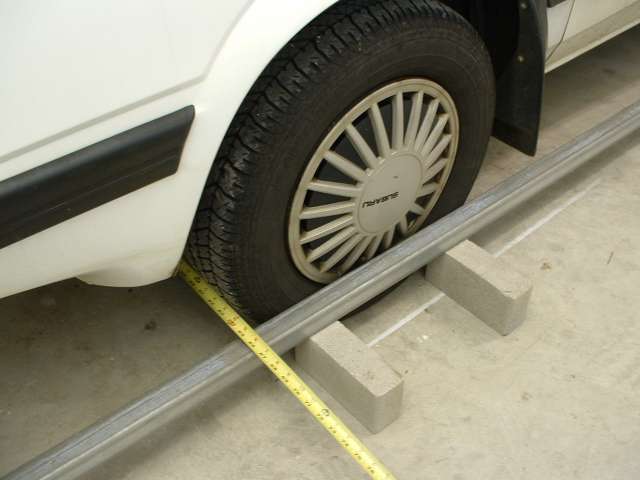
Here is a pic of my Toe in adjustment check. The 2 blocks are about 3-1/2" tall. The metal bar is actually 10' of Unistrut. It doesn't need to be 10' long. I used it because I have a bunch. What you need is a straight bar. Heavy helps, as you want it to stay touching the tire. Be sure it is not touching the hubcap. Set up a duplicate of this on the opposite side. Measure at the front & rear of the tire. I use 2 tape measures to save time.
-
I second the radiator, just to confirm. Check the fine fins between the tubes. If they are loose, falling out or missing - it's new radiator time. Especially check where the electric fan shroud hides the fins.
-
Here are a couple of things I've had happen: One of my older Subes was in an accident. I discovered a bent strut - that the collision repair shop missed. I didn't know it was bent until I was installing a new cartridge. They were the rebuildable struts on my 76. The cartridge slid in but stopped a few inches before it hit bottom. The bend was not visible with the strut on the car. It handled better after replacing the bent strut. EA82 alignment experience: One morning I ran the left front wheel into a golf cart battery. Low speed, just moving in the driveway. After a few days, I discovered that my front tires were wearing badly, on the outside. They even bubbled the tread off the steel belts. I looked & looked for bent parts, etc. Put on another pair of (used but good) tires, killed them in about a week, also. For lack of any other ideas, I got out the manual, and checked the toe in. It was way off. Adjusted it, even centered the steering wheel. The car steered better than it did before the incident. Tires lasted longer also, so it was out a bit before my oops. Toe in is easy to check. I use a pair of straight bars, setting on blocks near the wheels. Push the bars against the tires. Use a tape measure from on side to the other, just in front & just behind the tires. If the measurement is different by more than 1/8" I'd start looking at adjusting. (get out the FSM & check the official specs)
-
I've had them fail both ways. Quick failure, big leak & smoke show, and slow, small leak, no symptoms until the car doesn't shift right.
-
Going from memory - I think the factory wiring makes the fog lights go off when you switch on high beams. The relay "G" pin wired to the red/yel is my guess. The white w/ fuse holder should be battery +. To use a toggle, it looks like ground the "G", feed accessory + to your switch, switch to the "S" on the relay. If you temporarily wire a lamp in series with any + 12V feed wire into the unknown / unsure circuit, you have a current limiter that will protect most of the parts & fuses. For a relay signal, use a brake light bulb, heavier current, use a headlamp.
-
Welcome. 1 - could be loose shields. Bang on them when cool, if you hear a similar sound, remove the loose ones. Other possibility - Most of my EA82 cars don't like 87 octane & ping during mild crusing. It sounds similar to a loose sheild. 2 - I have run both tires you mention. Never noticed a difference. I don't like the 185s because they don't fit in the storeage space in the engine compartment. 3 - Not sure... These aren't luxury cars. Check all the other suspension parts? 4 - Some run no covers - I have 1 w/o, my main concern is if a mouse decided to make a nest in there.... The pullys get more surface rust if you drive infrequently. 5 - I didn't either, but with road rage & carjackings, I decided it isn't a bad idea. 6 - I get around 21mpg. Heavy on the accellerator. 65MPH on the highway. 65 is about 4000 RPM on all but 1 of my EA82 wagons. I'm not sure what is off on the one different one.
-
I agree with GD & the others with the details. I did some looking a while back, found these: http://www.suvlights.com/product_info.php?products_id=46&osCsid=685950d0c15e445445a9ce0c2acbcb7b They might even fit where the front turn signal lamps are - of course, those have to be relocated somehow...:-\ I'm thinking about building LED headlights that fit in place of the stock ones - what to use for the lens is the challenge...
-
I have learned - if you hear that dead bearing sound - find it & fix it, or you will be stuck somewhere. Sometimes it is the fan belt idler, sometimes one of the 3 timing belt tensioners / idler.
-
A few bits of info from my experiences: Smoke has nothing to do with once / week. The white smoke could be a small intake manifold leak - coolant passage to intake. If one hose had a leak, replace all 7 coolant hoses. I would either have the radiator cleaned & tested or replace it. Stop leak = bad - last resort to limp home. Check the fine fins that are between the tubes of the radiator - if they are loose & falling out, get a new radiator. Especially in the corners of the electric fan shroud. I got an all metal, non - china radiator here: http://www.usaradiator.com/ You can have a small head gasket leak that lets combustion gas into the coolant passages. Over time there will be black gunk leaving a ring in the coolant overflow tank. Every EA82 engine I have ever had run hot - even once - with low coolant has needed at least a head gasket job - instantly or months later, or in between. I never ran one repeatedly with cooling problems .
-
Yes, bolts would be all wrong. With a stud, there is full engagement of all the threads before any tension is built up by tightening the nut.