
idosubaru
-
Posts
26993 -
Joined
-
Last visited
-
Days Won
344
Content Type
Profiles
Forums
Gallery
Store
Everything posted by idosubaru
-
That's a GREAT idea, I don't have a great clamping point due to the small access, i'm clamping to the bolt head so it's going through that and into the captive nut, probably not a good connection. It'll be a pain. my angle grinder and sawzall are always at an angle and can't cut flush, they're always hitting something, something is in the way, it'll be convoluted. possible but probably a multi-step process.
-
i did try that but wasn't getting much, not much room, leverage to work with and gouge the metal but i think this is what's needed. it kept cutting on and off like it wasn't properly grounding, probably a clear indicator it wasn't grounding.
-
grinding yes. vice grips won't work though. as you open the handle it doesn't even come close to fitting - handles run into the frame rail area. very little room for anything. i can get a box ended wrench over it - that's about it, no more room for any handles opening, etc. in the same way you're thinking though, i've considered cutting a notch in the side of the fastener to put a large chisel into and hold it in place. the bolt/fastener are loose and wiggling in place, so they're not tight to the vehicle, just corroded. i guess if i have room to cut a notch i can probably just cut it off. is the wedge comment a poke at my fondness for XT6's? LOL that would be awesome, not enough room to get a nut on top of the bolt as it's very close to the ceiling - i was going to thread a nut on and tighten it. anything completely circular in form won't work unless it's very thin. thanks guys: current approach is: 1. grind and expose metal 2. turn up amps all the way on welder 3. cut notch/drill hole in captive nut to try and pin it in place 4. cut off the bolt 5. weld a nut to flat plate (or a wrench) and have that plate extend through the bottom cut i've already made as i weld it all back together. are wrenches weldable - they have that "chrome" plate?
-
i don't know anything about welders. mine can't be fitted with gas...i would assume i have flux-core wire but i'm not even sure what that means. i've welded sheet metal before, welded the frame of my Kubota tractor (not your average Lowes grass cutter), etc, and it holds fine so I expected it to work here?
-
i have a die grinder. why is that quicker than angle grinder (i have both)? it would certainly give me better access/articulation with the air die grinder, I never use that to cut off stuff, i need to change that. where/what attachments do i get to use that to cut - is that obvious at a parts store? those hard bolts take forever, they're nearly impossible to drill out.
-
i'm using propane since it's more available in a rural area and the acetylene did scare me! hopefully i can just get the dumb thing welded, but i may practice burning a bolt head off the car to see. eventually i need to learn to use that torch. the sawzall has no good angle to cut, pressed up against the car the blade isn't "flush" or parallel it's at an angle to cut the bolt head, so it'll be a long messy battle to cut it off. i'll have to remove the control arm, cut the transverse link bracket off so there's just a small square left under the bolt to have any reasonable access at all. which is fine...but then i'm still left with welding something in there!
-
I have a cutting torch - how hard is it to "burn" the head of the bolt off? Keep in mind I haven't dialed it in and have never cut with a torch before, let alone this one. The undercoating was catching on fire lightly while I was welding - so that's a little intimidating. I could then at least get a nut on there, but then it'll just be a debacle if someone tried to loosen that bolt in the future- alignment, etc.
-
are welders "with gas" or "stick welders" (i've never used either) small enough to fit in tight spaces?
-
i had it cranked almost all the way. i'll bump it all the way and hit it with a grinding stone on my drill and give it one more shot. the access is so limited making a line is unlikely. i thought about just welding a wrench or metal bar to the nut so it held it...same idea. i tried that a couple months ago. on a 2003 Outback Sedan, that is not the way to do this job, too convoluted due to the many layers of metal, deep access, many turns/indirect line of sight, etc.
-
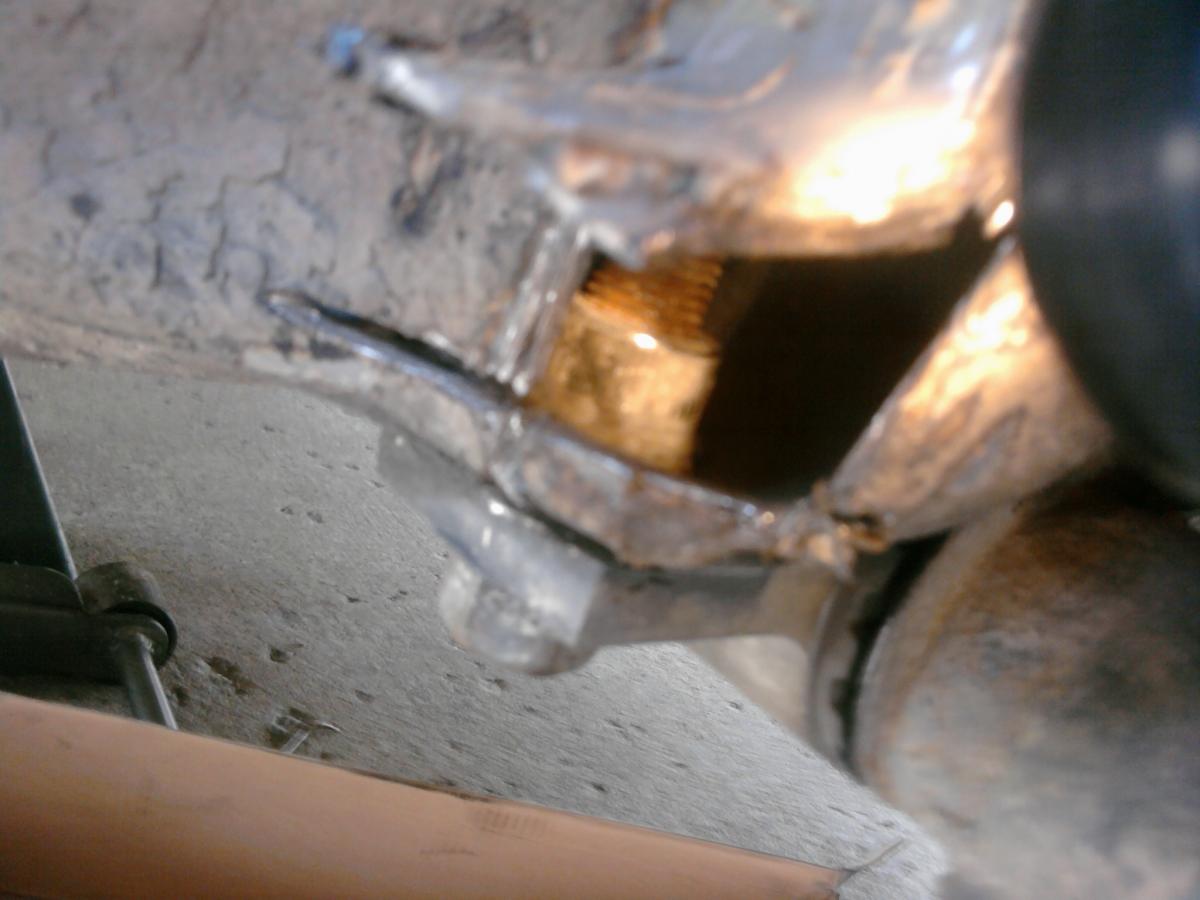
Yesterday I cut into the frame rail to address a broken captive nut on the front transverse bushing bolt on my 03 Outback. What a mess. 1. Welded the nut 3 times and the welds broke very easily. I have no access to clean the metal, is that the problem? * Would a better welder work? I'm using a cheap wire-feed mig with no gas. * Are other welders able to get into small places? I may try to squeeze a long grinding stone in there with a drill and clean up the metal and try one more time. One KEY that I've never seen mentioned - the captive nut is ***ROUND***. Picture attached. Can't get anything on it to tighten it by hand. The bolt is also too long to fit another nut on top of it. Cutting it out is going to be a debacle, there's no gap to get in between and every orientation of my angle grinder and sawzall puts it at an angle, not flush. If I ever see this on a vehicle that's not worth much I'd just weld the transverse bushing directly to the vehicle.
-
woah, weird. the trans pan isn't damaged at all is it? i picked up a trans and the pan was damaged. it was damaged so slightly that i actually wouldn't have noticed had the previous owner not told me. it didn't seem damaged, though he said he did try to repair the pan on the vehicle. he said it would drive but wouldn't shift correctly. when i pulled the pan 3 of the solenoids had tabs where the wiring harness connects cracked. should have an AT light if that's the case i would think though. i'm going to swap those 3 solenoids, another pan, and see how this transmission does. TCU? with no AT light flashing and it shifted fine sometimes, it seems like it has a small chance of working.
-
what he said about separator plate. common leak point. oil pan requires engine to be lifted to be replaced, but they don't really leak that often. if you're up to it, reseal it, but otherwise it probably won't be an issue. Subaru XT6's manual trans have low gearing and run 4,000 at 80 mph, so they'll see that for hours on end highway driving too.
-
any subaru engine will fit in any subaru for the past 25 years, any legacy/impreza/outback/forester/SVX/Baja. it requires rewiring the car. you'll either need to be up to that task or pay lots of cash for someone else to do it.
-
i asked that same question and others said that's not a good idea, but yeah if you're willing to try it, i'm sure it has a significant chance of working. the answer to "will it work" has a statistical answer, not a black and white answer. how much risk do you like to take and how much do you care? there's a 60% (something high) chance of success. that's good and it'll likely work. there's a 40% chance of failure - that's terrible odds for something so labor intensive and costly. it sounds like you don't care too much to just buy and install another transmission in which case go for it. my understanding when i was talking to Gloyale about this (he's done a bunch of front diff dial gauge adjustments, is that the dial gauge in this case goes through the differential drain plug and measures the ring and pinion contact there and can be done on the vehicle.
-
you're absolutely positive you didn't install the timing belts with one cam one tooth off? ring and cylinder wall wear is not a typical subaru block issue, but of course anything can happen in a cylinder containing explosions.
-
Timing belt tensioner failure cause?
idosubaru replied to joe5's topic in Old Gen.: 80's GL/DL/XT/Loyales...
totally normal, no big deal - there's no additional damage, just replace the timing belt components and you're done. the bearings loose grease over time, the bearings get hotter due to lack of grease, things start to snowball out of control until the pulleys either wear and fall apart or seize and the belt slides over them. the $60 - $80 ebay kits are the way to go - you get all new pulleys (3 of them) and the timing belts. replace them all every time, it's cheap insurance. if you're a penny pinching high mileage type you could replace the pulleys every other timing belt. the pieces you found are the grease seal for the face of the bearings in the pulley. as the bearings were compromised the seal came out of place and was shredded. -
www.car-part.com or classified section here for a transmission, craigslist. estimating high - $500 for a trans and $500 for install i'd look for $1000 tops, hopefully less. i know of a guy that installs trans for $350 and a trans shop that would install your supplied transmission (this was 10+ years ago) for $200. no warranty or replacing any additional parts, but they'd slap it in there.
-
turboing a non turbo ea82
idosubaru replied to drake13's topic in Old Gen.: 80's GL/DL/XT/Loyales...
Terrible idea practically and functionally. But if you're just wanting to play and tinker, go for it. gutless engine, still slow as dirt even with forced induction, and it'll introduce more single points of failure, make it less reliable, more failure prone, lots of work. if you're game and want to tinker and pay for less reliability, more work, and very little performance gain and still having a slow vehicle, then yes, go for it you'll certainly learn a lot in the process. but there's way better options for your time and dollar. If you're still game, you have to either custom make the exhaust piping or cut and notch your engine cross member or install a complete turbo crossmember for stock exhaust clearance. -
the cheap ebay gasket sets are to be avoided. you get what you pay for in those cases.
-
wow, how bizarre. good lucky knocking out the rear extension housing work, that's not an oil change to jump right into it like that. the first suspect here would be the rear speed sensor itself, why was that not replaced first? i wonder if the wrong Duty C solenoid was installed? around 03 - 04 there were changes to the operation of the Duty C solenoid. the newer style works backwards of the older style in terms of duty cycle powering it "on" instead of "off" so to speak. seems like you'd get a AT light flashing for that though and a code.
-
they're extremely good but not as accurate with platform specific issues that bear themselves out in a focused forum like this. if they did focus on one brand they'd be like USMB in radio format. but one person can't specialize in every make/model/platform/nuance.
-
i'm very aware of that, but in this case it's not the case, the manuals do not have FWD fuse holders. the possibility of it being an outlier is more rare than some other reason so it's unlikely. so now you can buy a failed VLSD center diff, install it, and run it in RWD instead. LOL yah, front differential binding means you need another transmission. www.car-part.com or classified section here save the center diff if you do swap transmissions. was the gear oil ever changed?
-
if the cam marks are lined up properly - and that's the same crank picture as when the cam marks are noted - then it's wrong. can you post a picture of the cams too and everything in one shot? i'm very hesitant to recommend changing the timing belt on a perfectly running engine, that doesn't make any sense. how badly did the water pump fail? is the water pump pulley compromised, thereby throwing off the timing artificially, like when bearings go out and the outer pulley isn't properly centered anymore. normally with this question, someone is simply looking at the wrong marks. that belt has more cracks and grooves than the moon, looks like it brushed up against the exxon valdez, it was used to paint white trim in a house, and the belt is improperly installed or noted. we need an auto-sherlock holmes section of the website. i'd be replacing that belt while you got it apart or looking for a good used one, i've got some lying around. ebay or Gates amazon kits are like $80 for all new pulleys and the belt - good for another reliable 60k.
-
since this issue is so rare and very difficult to DIY - here's another person with the same issue: http://www.ultimatesubaru.org/forum/topic/146646-98-outback-front-differential-retainer-didnt-mark-before-removal/
-
follow up after one year. after a few thousand miles it started groaning, then got louder. made it about 10,000 miles before it got demoted to me driving it (instead of my wife). i drove it about a month before the transmission locked up in the driveway - how convenient, i didn't have to get the truck and trailer! it's on the floor of my garage and i've got a replacement trans i'm cobbling together to repair it. hopefully back and driving soon. replacing all the H6 timing guides, tensioners, water pump while it's all apart too.