DaveT
Members
-
Joined
-
Last visited
Everything posted by DaveT
-
-
DaveT replied to elektrinis's topic in 1990 to Present Legacy, Impreza, Outback, Forester, Baja, WRX&WrxSTI, SVXThe transmissions I know best are the 3AT. The path is pump to regulator. Iirc, Regulator overflow goes to converter and then cooler. The regulated pressure goes to the control and lube systems. All of the lube system "return" is just what flows out from the bearings and all. The cooler is not under any pressure, other than what it takes to flow the oil back through the return line. The tourque converter doesn't need high pressure, just enough flow for cooling the heat it puts into the oil. It's kind of a big turbo pump loop. A big fan pushes fluid through another fan, getting the rotational energy through. The cooler helps get rid of the heat of moving all that energy.
-
DaveT replied to elektrinis's topic in 1990 to Present Legacy, Impreza, Outback, Forester, Baja, WRX&WrxSTI, SVXYour fancy pump idea would work as far as keeping the system volume constant. But would be the same as multiple drain aND fills, since the only some of the atf is sent to the cooler lines by the pump. As much goes to the clutches, bearings, gears, etc. Multiple return paths to the pan. This is why you need a big pan under the transmission when you do my drop the pan method. With the fancy pump, you still need 3 to 4 times the transmission oil capacity to get rid of most of the old stuff . Regarding the other post - the atf cooler line that returns fluid to the transmission simply drops into the pan, no suction there.
-
Spring needs to be where the cylinder is.
-
DaveT replied to elektrinis's topic in 1990 to Present Legacy, Impreza, Outback, Forester, Baja, WRX&WrxSTI, SVXA couple of ideas. Multiple drain and fill with low cost atf, then use good stuff for the last 2. Drop the pan, find the pickup tube, adapt a hose to it, to a tank (jug) of new fluid. With a big pan under everything, cycle through the gears.
-
DaveT replied to Ambolda45's topic in 1990 to Present Legacy, Impreza, Outback, Forester, Baja, WRX&WrxSTI, SVXA little more specifics would help. Lots of people on here have probably dealt with similar things.
-
Bad connection between battery and everything. Fusible link box, main fuse panel, ignition switch. A few connectors in between. Volt meter or test light to locate where it's dropping. Full schematics from the fsm are helpful.
-
Factory service manuals are best, complete schematics. Ignition just on, draws about 20 amps for everything trying run. Visual inspection doesn't always work. I don't recall the fuel pump amps, but I don't remember them being extraordinarily high. Not likely a wire this thick is broken inside the harness. It has to be a main feeder to drop everything. Flakey connections are flakey. I've seen a number of corroded / overheated connections in things cause similar behavior. A volt meter or test light at various points along the power distribution circuitry should help locate the point of failure.
-
Not ecu or alternator. Sounds most like a weak connection somewhere. It will carry a small load like done light. But not big current like the starter. Batteryclamp, fusible link box on coolant overflow tank, main connection on back of fuse panel under the dash. I've seen batteries fail internally with similar symptoms.
-
-
Ea82 temp gauges are notoriously inaccurate. I have had a few that are normal below 1/4 as well as a few that read about 1/2 when at normal engine temperature, verified with a real thermometer.
-
DaveT replied to Bendz's topic in 1990 to Present Legacy, Impreza, Outback, Forester, Baja, WRX&WrxSTI, SVX+1 on likely headgasket beginning to fail. How to check coolant level- note coolant level in the reserve tank. Sharply squeeze the upper radiator hose. Listen for the jiggle pin and air gurgles. There should be little to no air. Running over normal temperature, (does not have to get to the red) while low on coolant accelerates headgasket failure. If closely monitored - as in check before every cold start - I've gotten away with delaying the headgasket repair a few days to a few months by just keeping the system refilled, but it is temporary and unpredictable trick to buy time to find the original leak, or reseal an engine to swap in.
-
I'm educated guessing here - but if the IAC valve is open, I'd think it would raise idle. Not a leak. Its more like gas pedal part way down. MAF senses more air flow, so ECU sends more fuel. RPM goes up. A vacuum leak would lean out the mixture - I've only seen vacuum leaks make an engine run crummy, not increase RPM. O2 sensor has no effect until the engine is up to normal operating temp.
-
12V won't fry it. If it didn't react - click and move - it was already dead, or very stuck.
-
DaveT replied to goblinsgarage's topic in 1990 to Present Legacy, Impreza, Outback, Forester, Baja, WRX&WrxSTI, SVXWhat you describe is a dead CV joint. If by some chance, you guess the side wrong, swap the removed one onto the other side. I don't know your specific model, but everything I've seen regarding CVJ / axles is OEM only. There used to be a few aftermarket ones that were ok. Get a used OEM axle at a parts yard, get a set of boot kits, and reboot it. Probably good to change all the lubes at least every 100Kmiles, but it's got nothing to do with a failing CVJ. Check all of the suspension bushings, mounts, links, ball joints, etc.
-
-
It's rare to need a new oil pump. More likely, just need the seals. It should have an EA82 engine. Any year, spfi or carb is the same pump. Not sure if turbo is different. +1 on timing belts and all idlers, and all of the coolant hoses. Adding A/C is a big project. Wouldn't do it without a doner car.
-
Sounds like maybe just whatever makes the friction for the blend door is worn... it's normal for most of the useful range to be in the top 1/3 to 1/2 of the lever travel. The top 1/4 makes a huge difference.
-
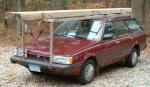
DaveT replied to miatapasta's topic in 1990 to Present Legacy, Impreza, Outback, Forester, Baja, WRX&WrxSTI, SVXHere's the hitch mount I made for an older [EA82] wagon: http://www.dynahoedave.co.nf/hitch.html It would have worked for a winch also. They key is to spread the loading to lots of points.
-
If it had mice in it, they often chew up the padding that seals the selector and blend doors. So they wont completely shut off airflow. That is what happened to my 87. I had to remove the dash and disassemble the entire HVAC system to clean and repair the damage. I *hate* mice. I put hardware cloth over the openings in the body to HVAC ports before I put it back together.
-
-
DaveT replied to NewKens1's topic in 1990 to Present Legacy, Impreza, Outback, Forester, Baja, WRX&WrxSTI, SVXDefinitely flow and leak check the radiator and heater core. Also consider replacing all of the several cooling system hoses, not just the 2 radiator hoses and the 2 heater hoses.
-
DaveT replied to Rooster2's topic in 1990 to Present Legacy, Impreza, Outback, Forester, Baja, WRX&WrxSTI, SVXIt's not the distance traveled, or the age of the car, it's the destroyed engine if the belt fails.
-
Sounds like your ignition switch is worn out?
-
DaveT replied to Rooster2's topic in 1990 to Present Legacy, Impreza, Outback, Forester, Baja, WRX&WrxSTI, SVXInterference engine = do not mess around.